Hotel Booking App
How to Develop a Hotel Booking App? Features, Types, and Cost
bg green: Quick Summary * A hotel booking app lets travellers searc

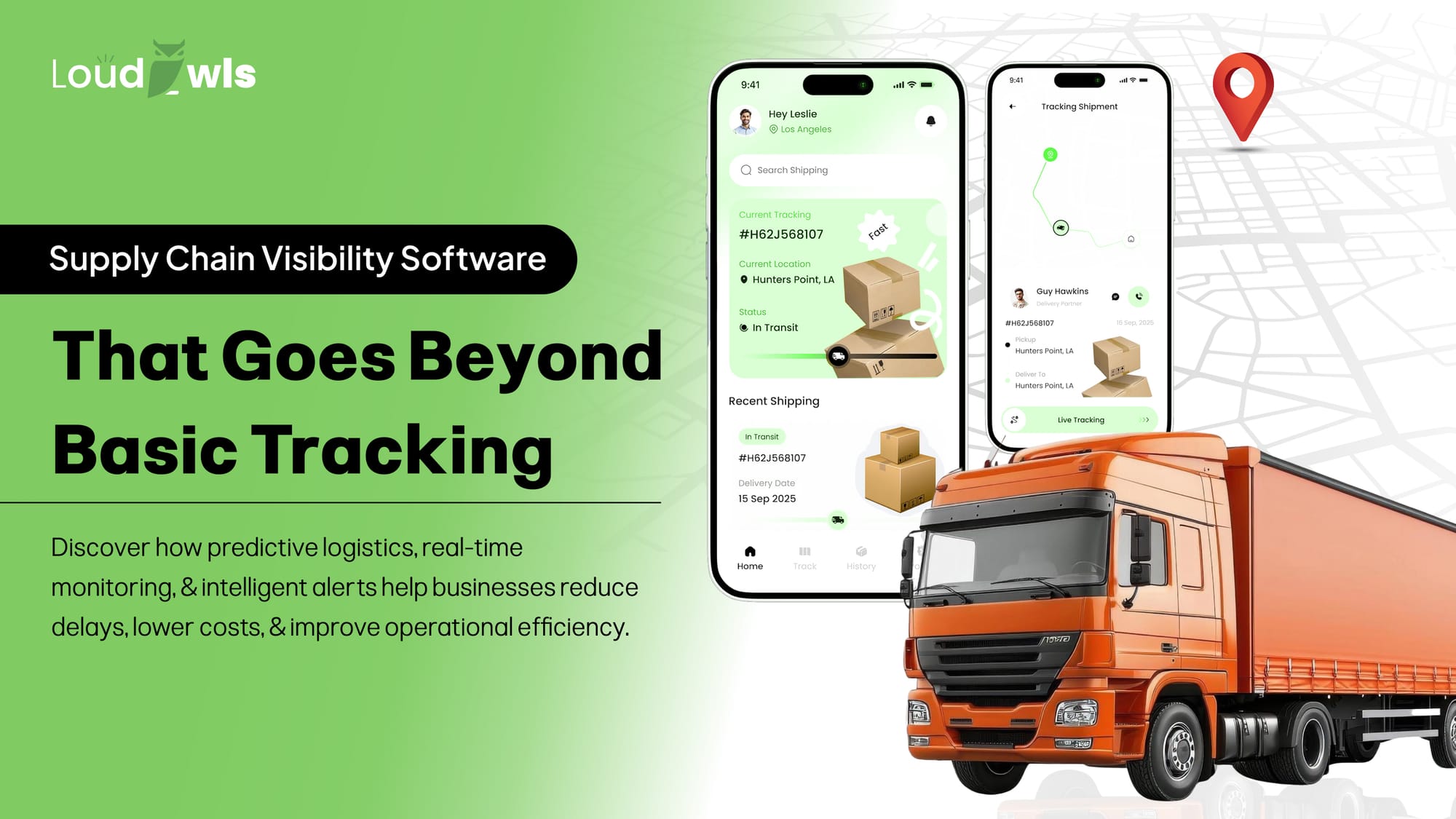

Most companies don't have a logistics problem. They have a visibility problem. The shipments are moving, the suppliers are delivering, and the warehouses are stocked, but nobody has a clear picture of all of it at once. Supply chain visibility software changes that. It connects the dots across carriers, suppliers, ports, and inventory in real time, so your team stops reacting to yesterday's problems and starts getting ahead of tomorrow's.
That is the gap between basic supply chain tracking and real supply chain visibility. One tells you where something is. The other tells you what is about to go wrong, how bad it will get, and what your options are right now. For most companies today, that gap is costing real money.
A 2025 industry report shows that a supply chain disruption, on average, resulted in a loss of 8% of annual revenue for companies in 2024. According to McKinsey, 90% of supply chain leaders experienced interruptions in 2024, with the typical business spending its first two weeks finding out about and reacting to an issue after it occurred.
The companies closing this gap are more than simply purchasing superior GPS trackers. They are looking to invest in supply chain visibility software that integrates real-time data with predictive analytics and intelligent alerts into one logistics management system.
Supply chain visibility software is a digital platform that provides real-time tracking of goods, inventory, and supplier activity across the entire supply chain. Unlike basic carrier tracking, modern platforms combine predictive analytics, automated alerts, and cross-system data integration, giving businesses the ability to detect and respond to problems before they escalate into costly disruptions.
In 2025, the supply chain visibility software market was estimated to be worth USD 3.1 billion with a growth rate of 13%, and it is expected to reach USD 10.4 billion by 2035. That is not slow, quiet growth. That is an entire industry waking up to the fact that reactive logistics is no longer good enough.
Part of what is pushing the numbers is sheer complexity. More than 72% of all business activities around the world have supply chains involving more than three geographical regions as of 2024. The more regions there are, the more times a player's ball is going to be moving from one player to another; there are more variables involved, and there are more chances for things to go wrong.
In the same timeframe, over 78% of global manufacturers reported visibility issues along their supply chains, and more than 64% of those saw an increase in the frequency of disruption in 2024.
Companies have attempted to reduce downtime and maintain on-time delivery rates by increasing real-time supply chain data integration by 53% over one year. Cloud platforms are leading the way, currently holding a 68% share of the deployment model segment. The shift to cloud-based supply chain monitoring software is not just about cost. It is about the speed of access and the ability to connect data from dozens of different sources without waiting for an IT project to finish.
This is where the discussion around supply chain software goes astray. The words are used interchangeably, and the use of each refers to a different set of capabilities.
Basic supply chain tracking answers one question: where is it right now? It pulls location data from carriers, gives you a status update, and logs delivery confirmations. That is useful, but it only looks backward. It tells you what happened, not what is coming.
Predictive logistics has a set of different questions. Will there be any delays with this shipment? Who's in danger of being delayed next month? What happens to my stock if I lose this carrier? It leverages historical information, live input, and machine learning to uncover answers before it's too late.
There's a solid business case for predictive logistics. Several studies indicate that predictive analytics can help to boost forecast accuracy by 20% to 50% and cut inventory costs by 15% to 25%. DHL reported 15% transportation cost savings after implementing predictive tools. Walmart achieved up to 25% reductions in inventory holding costs. Companies using predictive risk management experienced 45.3% fewer supply chain disruptions.
For example, a pharmaceutical distributor that integrated live temperature sensor data into its logistics visibility platform caught a refrigeration unit failure mid-transit - before delivery, saving an entire batch from spoilage.
Here is how the two approaches compare across the key areas that matter in day-to-day operations:
Not every supply chain management software product does what it claims. The category has gotten crowded, and plenty of platforms offer a long feature list that falls apart under real operational conditions. These are the capabilities that actually move the needle.
A platform is only as good as the data feeding it. The best real-time supply chain tracking systems pull from IoT sensors on shipments, GPS devices on fleet vehicles, EDI feeds from suppliers, port authority data, and weather services, all at once. Those platforms that need manual data entry or batch updates will never be up to date.
When a shipment is at risk of running late, and you want to know two days before the delivery window closes, not two hours after it has passed. Good supply chain visibility software calculates expected arrival times based on current conditions, including port congestion, carrier history, and weather, and flags risk early enough to do something about it.
Visibility does not stop at your own warehouse. Monitoring software is not very effective in the supply chain, as it only focuses on tracking both inbound and outbound shipments, whereas most issues begin at the supplier level. Supplier scorecards, on-time delivery tracking, and quality trend monitoring provide procurement teams with actionable information instead of just reporting.
Knowing you have 5,000 units in stock is not the same as knowing where those units are across your warehouse network and when they will be where demand actually is. The inventory visibility in a proper logistics visibility platform means seeing stock levels across every warehouse, transit node, and retail location in real time and connecting that picture to incoming orders.
One consumer goods company using node-level inventory visibility was able to redistribute stock between regional warehouses based on live demand signals, cutting their safety stock requirements by 18%, without a single stockout.
Nobody wants 400 notifications a day. The platforms that work well in practice are the ones that filter noise. They surface the things that actually need human attention and route those alerts to the right people. An exception-based alert system is what separates a useful tool from one that people stop checking after a week.

How to gain stronger visibility of the supply chain is always a topic, and the solutions are usually too general for practical application. Here is what the process actually looks like in practice.
The first step is mapping where your data currently lives. Most mid-size companies have supply chain data sitting in three or four disconnected systems: an ERP, a freight portal, a warehouse management system, and spreadsheets that someone built two years ago. Before any platform can give you visibility, those sources need to connect.
The second step is identifying your highest-risk lanes and suppliers. Not all parts of your supply chain carry equal risk. Predictive logistics starts by pointing analytics at the segments most likely to disrupt so that early warning is targeted where it counts.
Third is defining what your team will actually act on. Real-time supply chain tracking only works if the alerts lead somewhere. Who sees the alert when a shipment is at risk? What authority do they have to reroute or reallocate? The software supports the decision. The process has to be there first.
77% of logistics partners now invest in predictive analytics specifically for supply chain risk visibility, according to the 2024 CSCMP State of Logistics report. The ones that see the best returns are the ones that connected their data, defined their use cases, and built the operational process alongside the software.
There is a mix of enterprise platforms and newer, more niche players in the market. They each have their own solution, and knowing where they fall on the spectrum can help businesses determine the appropriate solution for their size and complexity.
LoudOwls develops custom supply chain management software for businesses that need precision and speed without the overhead of an enterprise platform rollout. The idea is to build to fit, rather than configure to approximate, for logistics teams and operations managers who require visibility into their actual supplier and carrier networks.
That involves real-time supply chain tracking and linking to real data sources, predictive alert logic based on your actual risk thresholds, and dashboards that focus on your actual decision-making daily. No generic interfaces. No features that nobody uses. No three-year implementation timeline.
From freight-heavy distributors to multi-location manufacturers, the goal is the same: a logistics visibility platform that gives your team the information to act before a problem becomes a cost. That is where LoudOwls can help. Get in touch to discuss what your supply chain visibility setup currently looks like and where the gaps are.
It's an online system that can be used to track and monitor goods, suppliers, shipments, and stock all the way along the supply chain, in real time. The best platforms bring predictive analytics to their platforms to preemptively identify risks and potential disruptions.
GPS tracking provides you with a location. Real-time supply chain tracking links location information with carrier performance history, port congestion, weather information, and supplier inputs to provide a comprehensive view and alert you to delays before they arrive at your door.
It tracks the condition of each shipment, how well suppliers are delivering, stock at warehouses, how reliable the lanes are, and any exceptions (caused by delays, damages, or customs holds). The aim is to bring the appropriate information to the right person at the appropriate time.
Traditional tracking only shows where a shipment is currently located. Predictive logistics uses AI, historical data, weather conditions, and carrier performance to forecast delays, disruptions, and delivery risks before they occur.
Yes. Most modern supply chain visibility platforms integrate with ERP, TMS, WMS, and procurement systems to create a unified view of operations and improve decision-making across departments.
Industries with complex logistics networks, such as manufacturing, retail, e-commerce, healthcare, automotive, and food distribution, often see the greatest benefits from enhanced visibility and predictive insights.
Many organizations begin seeing measurable improvements within a few months through reduced delays, lower inventory carrying costs, improved customer satisfaction, and better operational efficiency.
AI brings several meaningful advantages to supply chain visibility software. It can process data from dozens of sources simultaneously and surface patterns that would take human analysts days to identify. Practically, this means earlier disruption alerts, more accurate delivery forecasting, smarter inventory reorder triggers, and supplier risk scoring that improves over time.

bg green: Quick Summary * A hotel booking app lets travellers searc
LoudOwls
Quick Summary * A social commerce app blends product discovery, social interac
LoudOwls
Quick Summary * Food delivery app development in 2026 ranges from roughly $20,
LoudOwls