Food Delivery App
How Much Does It Cost to Build a Food Delivery App Like Talabat in 2026?
Quick Summary * Food delivery app development in 2026 ranges from roughly $20,


Quick Summary

A social commerce app is a mobile application that combines social networking features, such as feeds, profiles, and messaging, with direct in-app product discovery and checkout.
Unlike a standard e-commerce app, the shopping journey starts inside a social feed rather than a product catalogue. Instagram Shopping, TikTok Shop, and Pinduoduo are widely cited as reference models, each targeting different buying behaviours.
Content and retail used to run as two separate disciplines. Social commerce collapses them: a shopper watches a video, sees a tagged product, and checks out without opening a second app.
That shorter path from discovery to checkout is the main difference between social commerce and traditional shopping apps.
The timing works in your favour because shopping behaviour has already shifted toward social discovery, and major platforms keep adding commerce tools to capture this shift.
TikTok Shop, Instagram Shopping, and Facebook Shops now compete directly for the same checkout moment.
The timing case rests on real growth numbers. US social commerce sales will surpass $100 billion for the first time in 2026, an 18% year-over-year jump that pushes the channel past 6.9% of total US retail e-commerce.
That share is projected to keep climbing through the rest of the decade as more shoppers complete checkout without leaving the app. Younger buyers are driving most of that shift, and their habits set the pace for the category.
A growing buyer base, rising social commerce spend, and shrinking checkout friction explain why founders and brands are prioritising this build over a generic online store.
It suits three types of businesses well, and not every brand needs one.
Starting with social commerce before there is any audience tends to leave the feed empty. That undermines the entire discovery model.
The key features of a social commerce app usually fall into five functional layers. Missing one may create usability or retention challenges later.
Users need a profile with purchase history, saved items, and a follow or friend system. The graph is what separates a social shopping app from a plain storefront, since it drives recommendations and repeat visits.
A scrollable feed with shoppable posts, short video, and tagged products is the core discovery surface. Search and category filters still matter for users who arrive with intent rather than browsing habit.
In-app checkout, cart management, order tracking, and returns need to work without redirecting users to a browser. For US builds, this layer also carries the payment gateway integrations covered later in this guide.
Multi-vendor or multi-creator apps need listing management, a dashboard for orders and payouts, and affiliate or commission tracking. Add this layer and a shopping app becomes a two-sided marketplace.
Reviews, verified badges, content moderation, and fraud detection protect both buyers and sellers, with clear return policies mattering more as BNPL becomes standard at checkout.
These five layers work as a set. Skip one and the experience breaks: a feed without fast checkout is just content, and checkout without trust signals struggles to convert first-time buyers into repeat ones.

During social commerce app development, teams choose between native development and cross-platform frameworks like React Native or Flutter, largely based on how video-heavy the feed will be. This choice also shapes social shopping app development for creator tools and real-time interactions.
Teams weighing social shopping app development against a simpler catalogue build should scope this decision early. Native apps handle video-heavy feeds and live shopping with less lag, which matters for a discovery-first experience.
Cross-platform frameworks cut development time and cost, which suits a smaller MVP budget. Backend choices matter just as much as frontend. The backend needs a database that handles both catalogue data and social graph data efficiently, along with a content delivery network for video- and image-heavy feeds.
Cloud hosting through AWS US-East or US-West, Azure's US regions, or Google Cloud keeps latency low no matter where your buyer base is concentrated. Real-time features, in-app messaging, live comments, and live shopping notifications run on a separate service layer such as WebSockets or a managed real-time database.
Planning for these requirements early can reduce major changes when live shopping is introduced later.
Monetisation usually combines two or three revenue streams instead of relying on one. Sales commissions are a common revenue model for marketplace apps, with rates varying by category and business model.
Subscription tiers for sellers who want premium placement or analytics add a predictable revenue base. Affiliate and creator commission programs work particularly well inside a social feed, since sharing is already a core behaviour.
Advertising is a fourth option, though it only pays off once the user base is large enough to make sponsored placements worthwhile. Founders looking to build a social commerce app usually start with commission and add the other streams once volume justifies the added complexity.
Most teams follow the same five-stage sequence, regardless of budget size.
The cost depends heavily on the tier you choose: MVP, mid-tier with live commerce, or a full multi-vendor platform. US agency rates sit above offshore rates, and that gap widens once compliance and payment infrastructure enter the scope.
The tiers below reflect typical agency scoping for each build size.
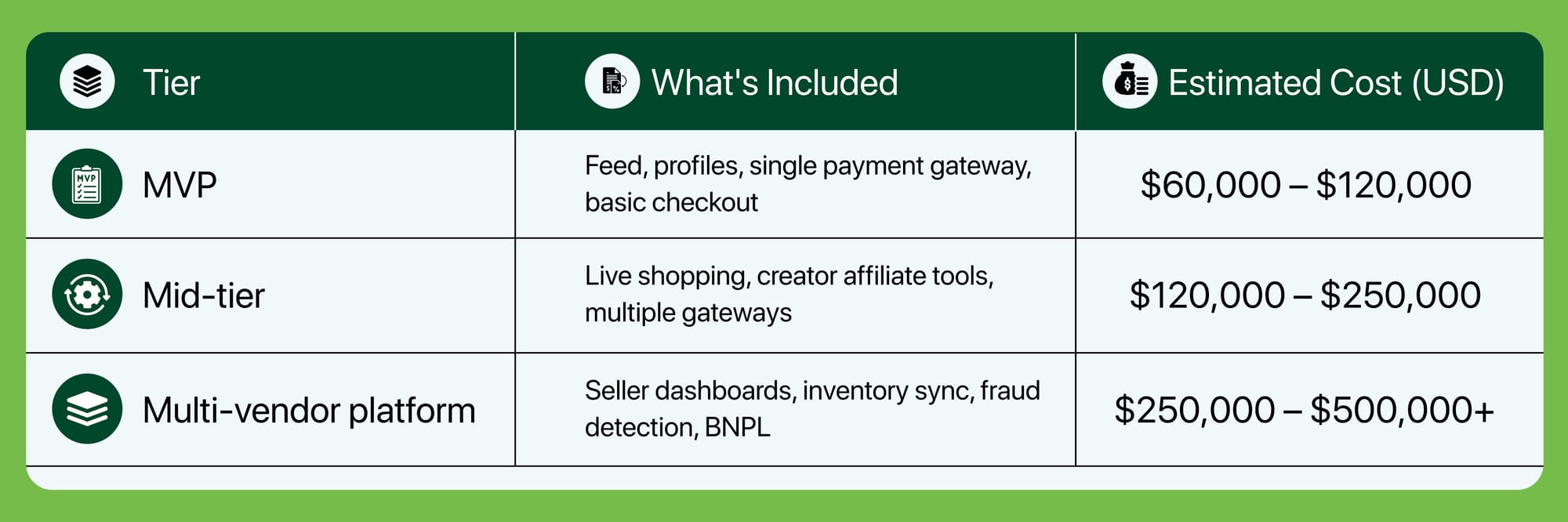
Funded teams building a genuine v1 with real workflows in the US typically land in the $80,000 to $250,000 window once discovery, design, and QA are included. Payment infrastructure is a separate cost line most founders underestimate. Integrating a processor like Stripe or Adyen runs $5,000 to $30,000 in development work.
A full payment facilitator setup, where the app owns more of the payment stack instead of just consuming a processor, runs $150,000 to $300,000 and pushes a build into the multi-vendor tier. Compliance is the other line item that gets skipped in early quotes. CCPA and CPRA violations can carry fines close to $8,000 per incident, which makes building privacy controls in from the start cheaper than remediation later.
Budgeting for compliance early is cheaper than fixing it after users are already on the platform.

The timeline for social commerce app development depends on feature complexity, platform requirements, and compliance needs.
Accessibility testing against WCAG standards adds real time to any of these tiers, so it is worth scoping into the original timeline rather than treating it as a post-launch add-on.

The CCPA and its expansion, the CPRA, are the compliance rules most US social commerce apps need to satisfy first, alongside similar state laws in Virginia and Colorado.
Most builds combine a primary processor (Stripe, PayPal, Adyen, or Braintree), a BNPL option like Klarna or Afterpay, and a digital wallet such as Apple Pay or Google Pay. Skipping BNPL is a common early mistake, since many US shoppers now expect split payments by default.
Fraud prevention matters just as much, especially for multi-seller apps. Verified onboarding, transaction monitoring, and PCI DSS compliance for card data round out the requirements.
Founders regularly mix up these three models. The build scope and monetisation approach differ enough between them to change both cost and timeline.
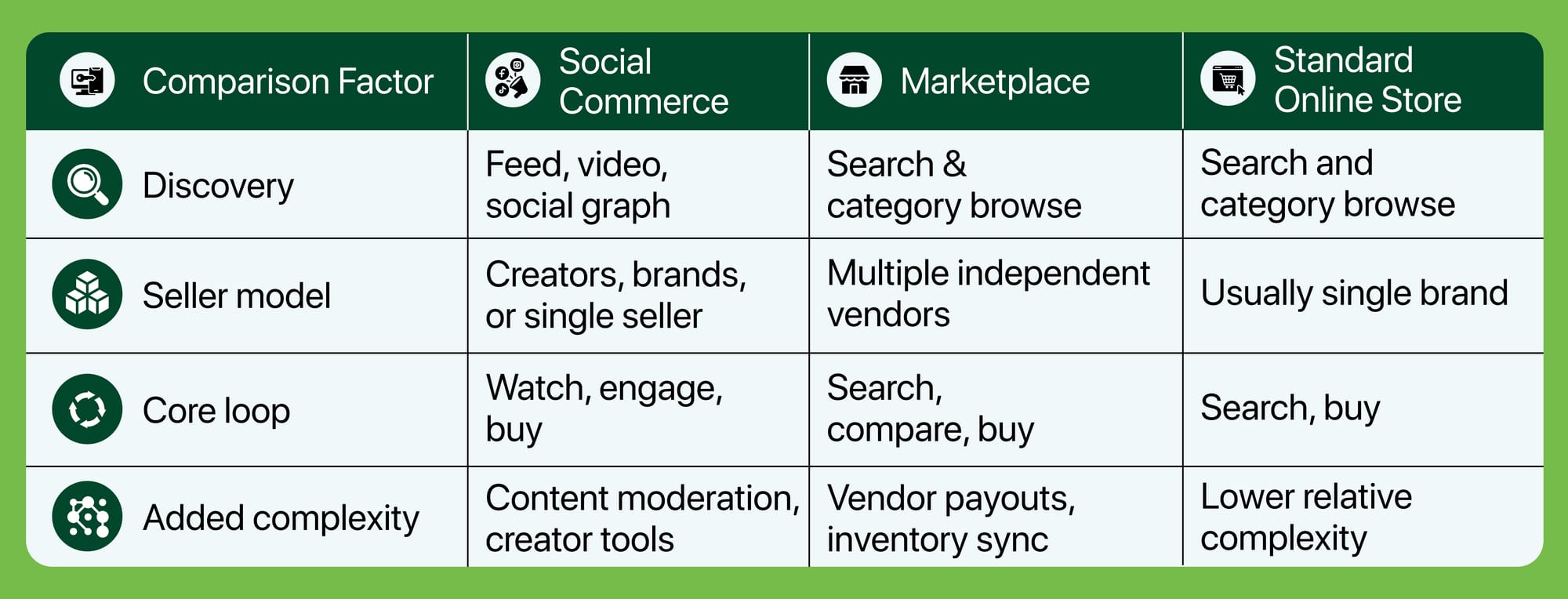
If your product already lives on social platforms, social shopping app development extends that behaviour. If you are building a vendor network from scratch, a marketplace app model may fit better.
The mistakes that cause the most delays and budget overruns are avoidable, and most trace back to the same short list.
Most of these mistakes come down to sequencing. Trust, retention, and revenue get built in that order, not bundled into one launch. Founders who sequence features around that order tend to launch with less rework.
A social commerce app lets users discover and buy products inside a social feed, while a regular shopping app relies on search and category browsing without a social graph or content feed driving purchases.
The cost to build a social commerce app in the US ranges from $60,000 for a lean MVP to $500,000+ for a full multi-vendor platform with advanced features such as live shopping, seller tools, and fraud detection.
Expect 3 to 4 months for an MVP, 5 to 7 months for a mid-tier build with live shopping, and 8 to 12 months for a full multi-vendor platform.
Stripe, PayPal, and Adyen cover standard card payments, while Klarna and Afterpay handle buy-now-pay-later, and Apple Pay or Google Pay cover wallet checkout for mobile-first shoppers.
No, a marketplace model is not required. A single-brand build with a creator or influencer layer can launch without full multi-vendor infrastructure, then expand later.
Building a social commerce app starts with defining your niche and seller base. Next, map an MVP around discovery, checkout, and trust features. Then choose a tech stack and payment partners before development begins.
The key features of a social commerce app span five layers: profile and social graph, discovery and feed, commerce and checkout, seller and creator tools, and trust and moderation.
Quick Summary * Food delivery app development in 2026 ranges from roughly $20,
LoudOwls

Quick Summary * Building an AI app can cost anywhere from $15,000 to over $500
LoudOwls
Quick Summary * This blog explores the latest mobile app development trends re
LoudOwls