AI app development cost
How Much Does It Cost to Build an AI App in 2026? A Complete Guide
Quick Summary * Building an AI app can cost anywhere from $15,000 to over $500


Quick Summary
Talabat has grown into one of the leading food delivery platforms in the Middle East, and it got there by nailing four things at once: fast onboarding for restaurants, dependable delivery windows, dead-simple checkout, and a loyalty layer that keeps customers ordering weekly instead of occasionally.
If you're researching food delivery app development because you want that kind of staying power, most of the blueprint is public knowledge at this point. What actually varies is the cost. That comes down to which pieces of the blueprint you need on day one versus later.
A single-restaurant MVP and a five-city aggregator share almost nothing in terms of budget, even though both technically qualify as "a food delivery app."
This guide breaks that gap into real numbers: what each build tier costs, what pushes spending up or down, how long a realistic timeline runs, and where founders get caught out by costs nobody quoted them upfront.
Talabat got its growth right by pairing a solid four-app structure with a business model built for repeat orders, not just a good-looking checkout. Its most recent full-year numbers explain why founders keep studying the playbook. Revenue climbed 33% at constant currency to $3.9 billion in 2025, with growth coming from higher order volumes plus expansion into grocery and subscription services alongside core food delivery (Talabat FY2025 results, Business Today Middle East).
That kind of growth rarely comes down to the app screens themselves. Order volume and category expansion move the needle far more than any single UI feature, which is a useful reality check for anyone budgeting a clone.
A serious clone of Talabat should be scoped around the retention mechanics that drive repeat orders, not just the checkout flow. The app is the interface. The business model is what makes people come back.
Building an app like this costs $20,000 to $300,000+ in the US in 2026, depending on how many of the four core apps you build and whether you go custom or white-label (Adevs, 2026 pricing breakdown).
A complete platform is four connected products: customer app, restaurant panel, driver app, admin dashboard. Here's how the cost breaks down by tier.
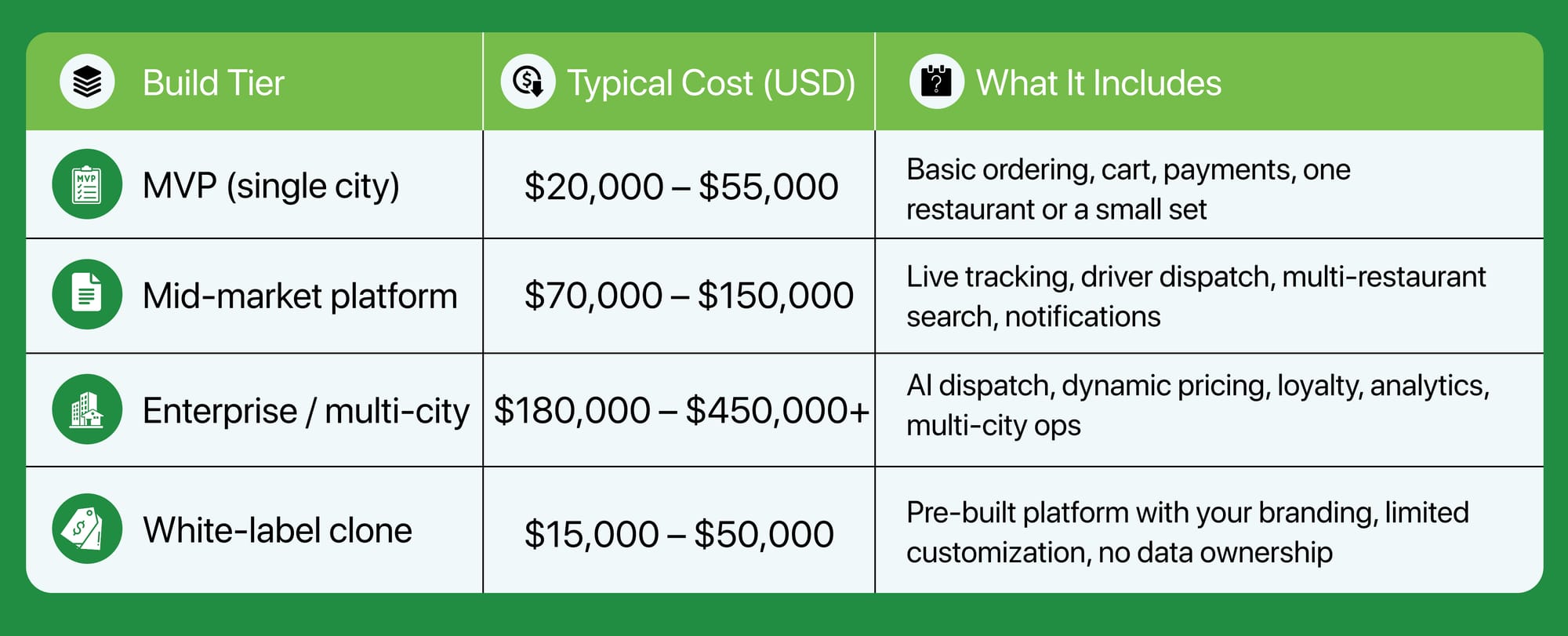
Expect $20,000 to $55,000 for a lean, single-market MVP with core ordering, a basic menu, cart, and payment flow.
The goal here is narrow: prove that restaurants can onboard without hand-holding, that customers can check out without friction, and that a driver can receive and complete an order end to end.
It won't out-compete an established platform, but it's enough to test real demand before committing serious budget.
Budget $70,000 to $150,000 once you're ready to run across multiple restaurants and neighbourhoods rather than a single pilot.
Live GPS tracking, multi-restaurant search and filtering, order-status notifications, and a working driver dispatch system all come into play at this stage. Founders building a genuine online food ordering app (something people actually reorder from) usually land in this band.
A full multi-vendor platform with AI-assisted dispatch, dynamic pricing, loyalty programs, and multi-city logistics starts around $180,000 and can climb to $300,000 to $450,000. At this tier, you're competing directly with apps people already have installed on their phones. That's an ongoing investment, not a one-time build.
Developer rates vary widely by region, and that swing moves the total budget almost as much as the feature list does (Growrankers, 2026 regional rate benchmarking):
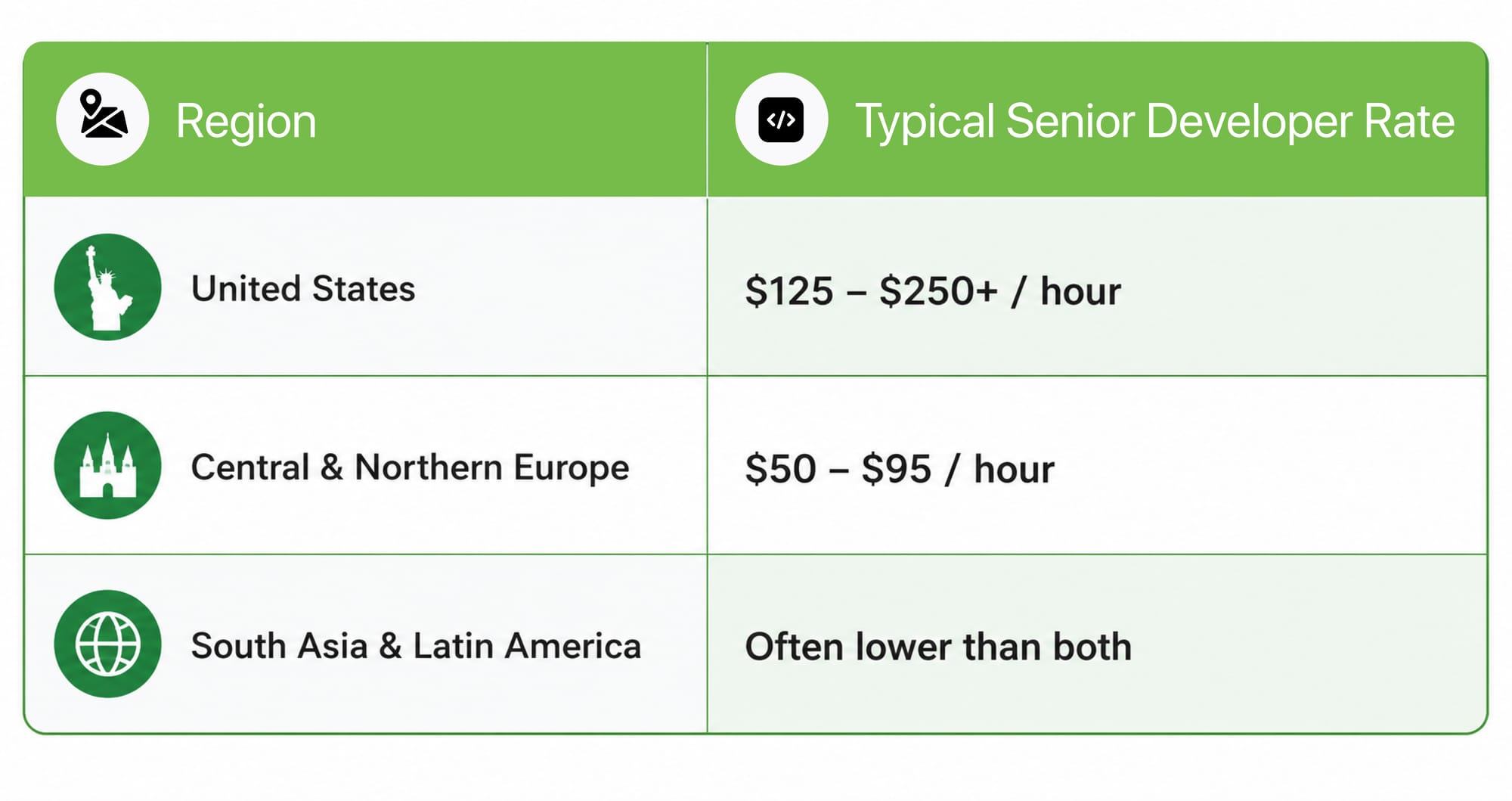
That gap is wide enough on its own to explain why two agencies can quote the same brief for a build like this ten times apart and both be defensible for their market. Rate alone doesn't settle the decision, though.
A cheaper hourly quote doesn't help if the team has never shipped real-time dispatch logic or PCI-compliant payment flows before.
Food delivery platforms tend to fail in production over missed edge cases, like a driver going offline mid-delivery or a restaurant marking an item unavailable after checkout, far more often than over slow code.
Before comparing rates, ask each vendor to walk through how they've handled situations like those.
Two projects can share an almost identical feature list and still land $50,000 apart, usually over decisions made in the first planning conversation, not hidden markups.
How many of the four connected apps you're building is the biggest factor. Real-time infrastructure adds the next layer of cost: live GPS tracking, order-status pushes, and mapping API usage that scales with volume, the main reason these apps cost more than a typical e-commerce build.
Payment complexity (PCI DSS, split payouts, refunds, tipping) and platform choice both add smaller but real weight. Cross-platform frameworks like React Native cost less than native builds, though native still wins for GPS-heavy features.
Feature-Wise Cost Breakdown
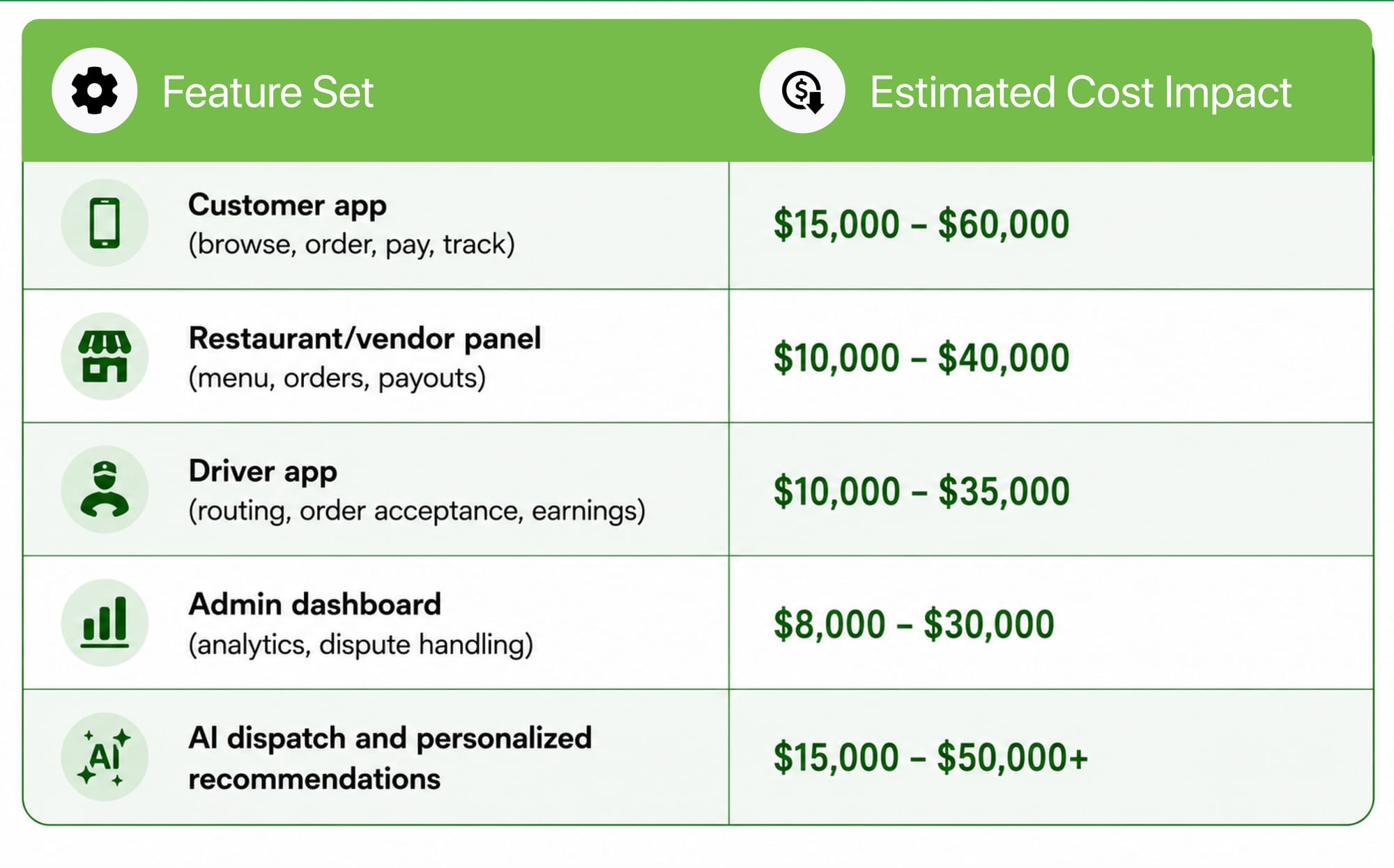
This build differs from a generic app because it prioritises a specific set of features from day one:
The right choice depends on whether you're validating demand or scaling past it. Both paths get you a working app; they differ in ownership, speed, and how far you can eventually grow.
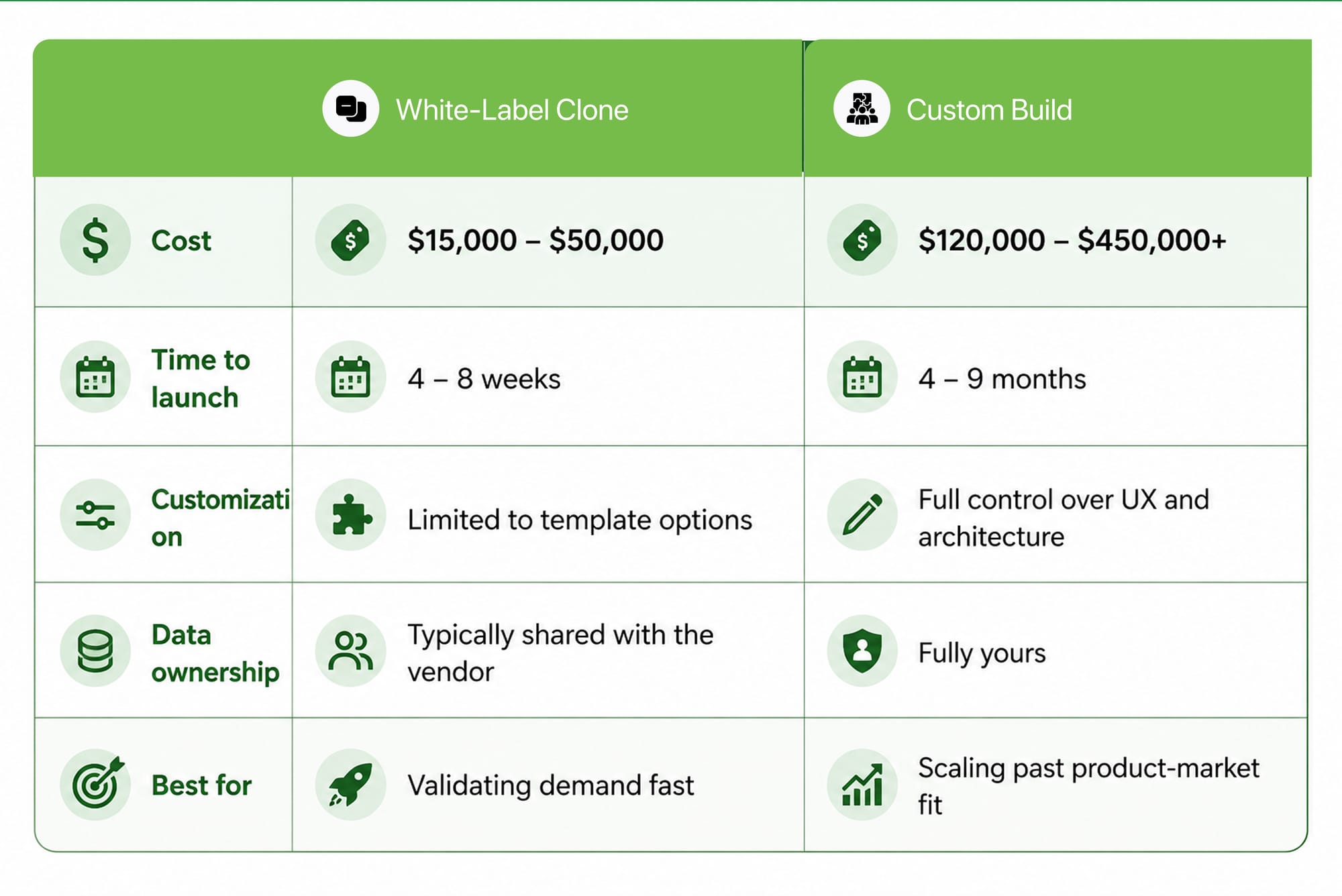
Few founders need to pick one path and stay there forever. A common sequence is launching white-label to test a market, then migrating to a custom build once order volume earns the investment. This approach avoids overbuilding for demand that hasn't shown up yet.

Timelines stretch most often around third-party integrations (mapping, payments, SMS or push notifications) that require back-and-forth approval from outside vendors, or around restaurant onboarding that needs a custom workflow instead of a generic template.
Not everyone researching this is building the next multi-city aggregator. A single-brand ordering platform (built for one restaurant group's own delivery and pickup orders) costs considerably less than a Talabat-style aggregator, typically $15,000 to $40,000, because it skips multi-vendor commission logic and third-party restaurant onboarding.
The choice comes down to where the revenue is supposed to come from. An aggregator model fits if the goal is marketplace commission across many restaurants.
This model fits instead if you already run the restaurants and would rather own the ordering channel than pay a third-party aggregator to sit between you and your customers.
Compliance surprises founders most: PCI DSS, ADA accessibility, and gig-worker classification rules add legal overhead that rarely shows up in an initial estimate.
Infrastructure is the quieter recurring cost. Mapping APIs, SMS notifications, and cloud hosting typically add 15% to 25% of the build cost every year, and API fees scale with volume rather than staying fixed.
Customer acquisition runs $1,000 to $10,000+ a month depending on your market, and support needs a real workflow once order volume passes a few hundred a week. Restaurant onboarding, photographing menus, formatting items, testing payouts, takes real staff time too.
None of this belongs in a "later" pile. Push your development partner to itemise every line upfront.
You keep the budget under control by sequencing spend instead of building everything at once. Launch an MVP first: core ordering, tracking, and payments up front, with AI features and loyalty programs added once real usage data can guide them.
Choose cross-platform development where it makes sense: React Native or Flutter typically cuts costs by 30% to 45% compared with building native iOS and Android apps separately.
Structure the contract in phases, paying for discovery and MVP first and committing to phase two only once demand is proven. Above all, expand gradually: one city, then two, then five, because building infrastructure ahead of paying customers just means paying for capacity nobody's using yet.
Building a food delivery app like Talabat costs $150,000 to $450,000 for a custom aggregator with customer, restaurant, driver, and admin apps. A white-label clone with limited customisation runs considerably less, typically $15,000 to $50,000.
A white-label Talabat clone app development approach is worth it for testing a new market quickly. You'll be live in weeks instead of months. The trade-off is less control over the UX and no ownership of the underlying platform or its data, which is easier to accept for a pilot than for a long-term platform.
The cheapest way to start a food ordering app development project is to strip the build down to one function: ordering and payment, on a single-city MVP. Driver dispatch, loyalty programs, and AI features can wait until there's real usage to justify them. Built this way, early costs typically land around $20,000 to $40,000.
A single-brand restaurant ordering platform takes about 8 to 12 weeks to build. It moves faster than an aggregator build because there's no multi-vendor onboarding or commission logic to design around.
Yes, food delivery apps need a separate driver app beyond a single-restaurant MVP. Route optimisation, order acceptance, and earnings tracking are jobs a customer-facing app wasn't built to handle.
An online food ordering app refers to just the customer-facing ordering and payment experience. A full delivery platform layers in the restaurant panel, driver app, and admin dashboard needed to fulfil and manage those orders end to end. If you already run your own delivery staff, you may only need the ordering half.
Quick Summary * Building an AI app can cost anywhere from $15,000 to over $500
LoudOwls
Quick Summary * This blog explores the latest mobile app development trends re
LoudOwls
Key Takeaways ● A food delivery app like DoorDash typically costs $150,000
LoudOwls