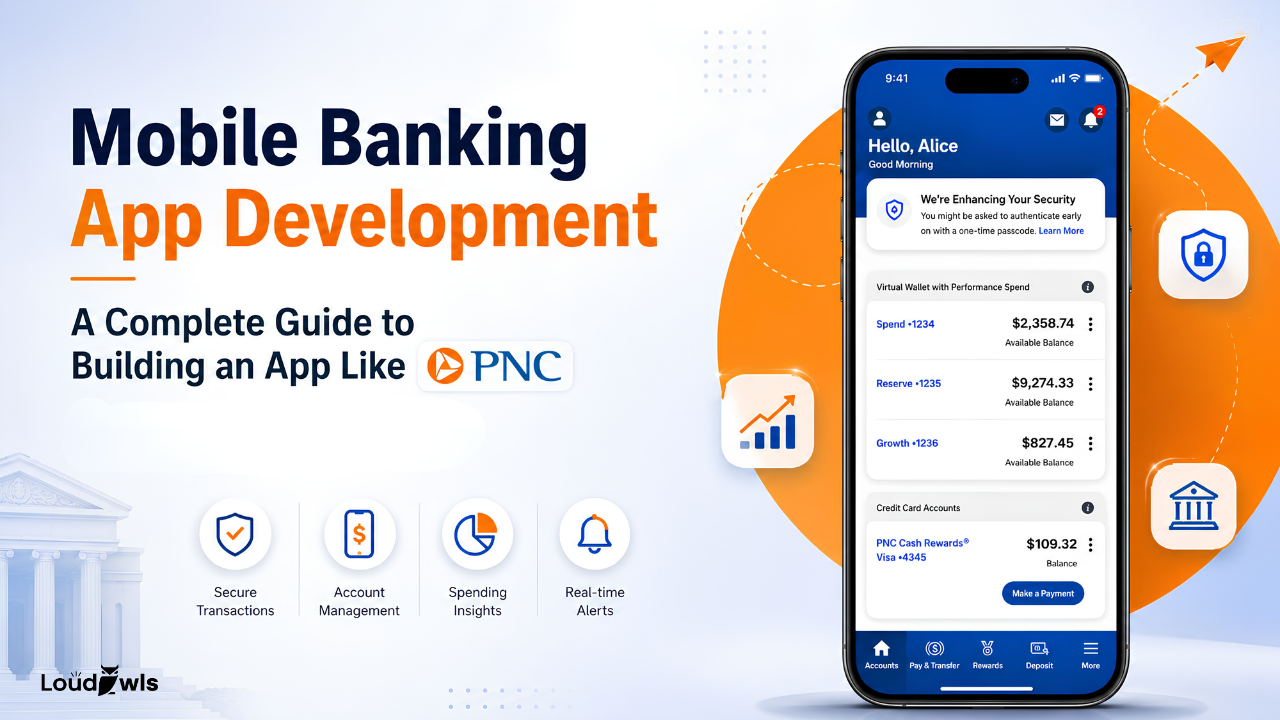
Mobile Banking App Development: A Complete Guide to Building an App Like PNC
BG green: Quick Summary
Mobile banking app development in the US usually runs $90,000 to $300,000. Compliance work eats up most of that budget.
A basic MVP takes 4 to 6 months. Want card controls and fraud tools too? Plan for 8 to 12 months.
Almost half of banked US households now use a mobile app as their main way into their account.
Security and compliance make or break a banking app, not feature count.
PNC's app is a solid example of what a mature, full-featured banking app looks like today.
[CTA button: Build Your Banking App](https://www.loudowls.com/contact-us)
A mobile banking app is a smartphone app that lets a bank or credit union customer check balances, move money, and manage accounts. PNC's app is one well-known example, right alongside Chase and Bank of America.
What Does Mobile Banking App Development Involve?
Mobile banking app development means creating a secure, regulated app that connects to a bank's core systems and lets people manage real money from their phone. That's a different job than most consumer app work. A social app can go live, break, and get patched later- no big deal, but a banking app doesn't get that luxury.
Every screen touches real account data, and one bug in the wrong spot can send money somewhere it shouldn't. That risk shapes almost every decision on the project, right down to where a button sits. That's why planning happens before building a single screen.
Security architecture, data flows, and compliance requirements all get mapped out early, since fixing these things later costs way more than getting them right the first time. Teams that skip this step usually end up rebuilding core work once an examiner or auditor shows up.
PNC's app covers account views and transfers. It also includes mobile check deposit and card controls. Budgeting tools round out the feature set. That's standard for a large US bank in 2026. It's also a solid benchmark for what "full-featured" really means.
Founders sometimes assume this is just a UI project. They think it's bolted onto a bank's existing data. In reality, the integration layer takes longer to build than the screens themselves. So does fraud monitoring and the audit trail. That's the part most cost estimates online skip.
Why Are US Banks and Fintechs Investing in Digital Banking App Development?
Banks keep investing in digital banking app development. That's where their customers already are. Nearly half of banked US households now use a mobile app. That's 48.3 per cent, their main way to access an account. That number comes from the FDIC's 2023 National Survey of Unbanked and Underbanked Households.
It's grown fast. Mobile banking use is up almost ninefold over the past decade. Bank teller visits are down by more than half over that same stretch. Browser-based online banking dropped by about a third. Every number points to the phone as the default channel now, not a backup.
For a bank, that shift changes the math on branches. A branch visit costs staff time and real estate. A well-built app handles the same task for a fraction of the cost. And customers expect that now. It's not a bonus feature anymore. It's the baseline.
Banks that treat mobile like an afterthought tend to lose younger customers first. Those customers rarely give a clunky app a second chance. For challenger banks and fintechs, mobile isn't a side channel. It's the entire product. That raises the bar on reliability. No teller exists to fall back on when something breaks.
What Features Does a Mobile Banking App Need?
Every real banking app needs a core set of features before anything else gets added. Miss one, and the app can't fully replace a bank visit for most customers.
Account access and balances. Real-time balance and transaction views across checking, savings, and cards. This needs to be accurate to the second, not some cached, stale dashboard.
Transfers and payments. Internal transfers, external ACH, person-to-person payments, and bill pay. Most people judge a banking app almost entirely on how smooth this one flow feels.
Mobile check deposit app functionality. Snap a photo of the check, submit it, and watch the funds post on a predictable schedule. This one feature drives a large share of app downloads for traditional banks.
A clunky mobile check deposit app shows up fast in app store reviews, often faster than any other complaint.
Card controls. Freeze a card, set spending limits, get instant purchase alerts. These features cut fraud losses and support call volume at the same time.
Authentication and security. Biometric login, device recognition, and step-up verification for higher-risk actions, like adding a new payee or raising a transfer limit.
Past this core set, most banks add budgeting tools, goal tracking, and in-app chat support. AI-driven spending insights are getting more common too, though they add real cost and need their own compliance review before launch.
Accessibility deserves its own mention here. It's easy to treat as an afterthought, but banking apps fall under the same accessibility rules as any public-facing digital service.
Screen-reader issues or bad colour contrast aren't just a UX complaint. They're real compliance exposure. Fixing them after launch costs more than designing for them from the start.
Notification design matters more in banking than in most other categories too. A fraud alert or low-balance warning has to reach the customer, no excuses. That means push notifications need a backup path, like SMS or email, for the moments a phone is offline or the app has been deleted.
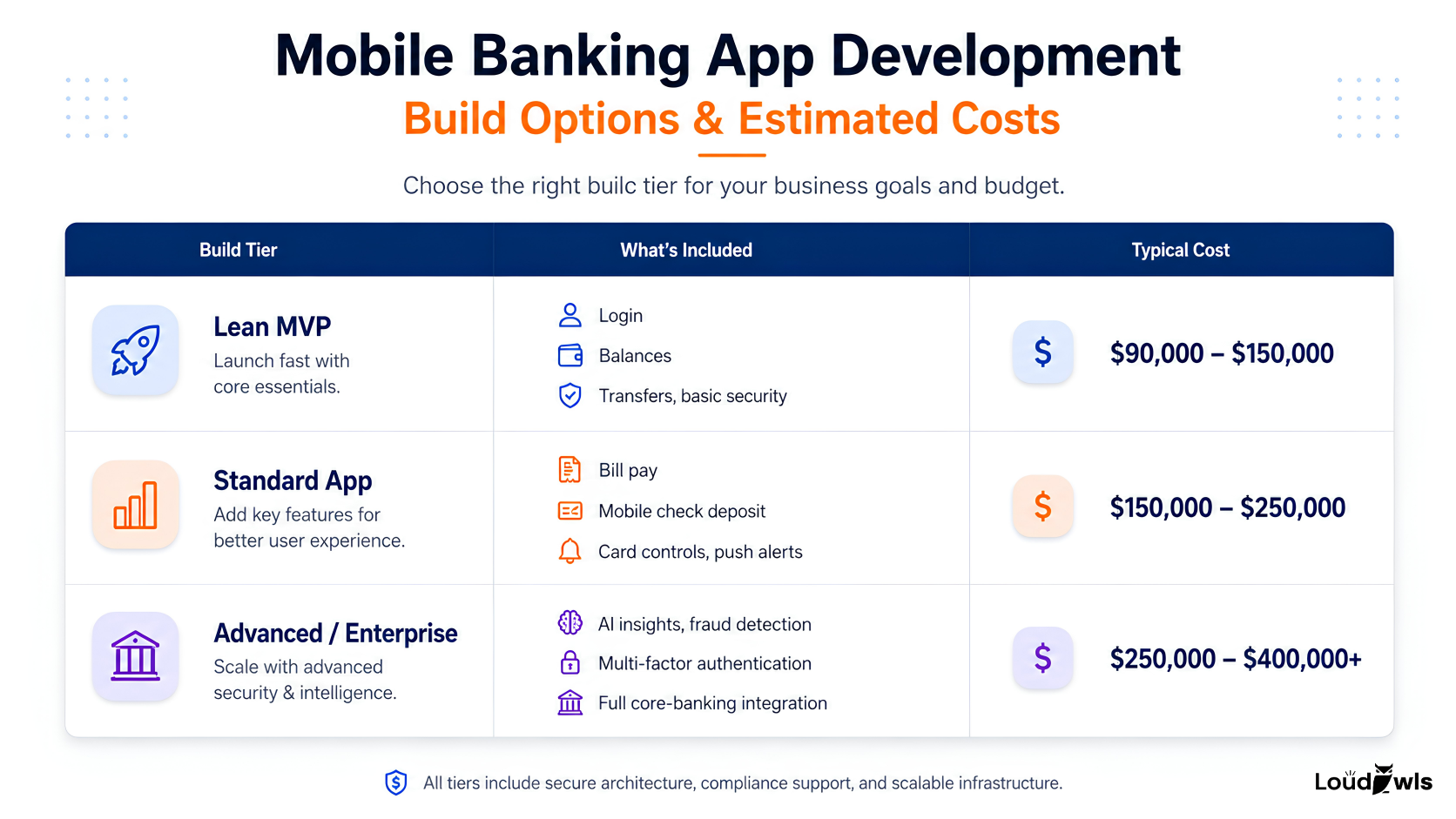
How Much Does Banking App Development Cost?
Cost here comes down to compliance scope, not screen count. That's the single biggest reason two quotes for the same app idea can land six figures apart.
Business of Apps puts a two-platform mobile banking build at roughly $287,000 on average, with the broader fintech category running $120,000 to $300,000.
Team location swings these numbers by tens of thousands of dollars. A US-based team costs more per hour than an offshore team.
That said, compliance-heavy work often benefits from a team that already knows US banking regulation. Fewer rework cycles can offset some of that rate difference.
Ongoing maintenance and compliance monitoring usually add 20 to 25 per cent of the build cost per year. That's higher than an average consumer app, mostly because security patches and regulatory updates never stop.
What Does the Development Process and Timeline Look Like?
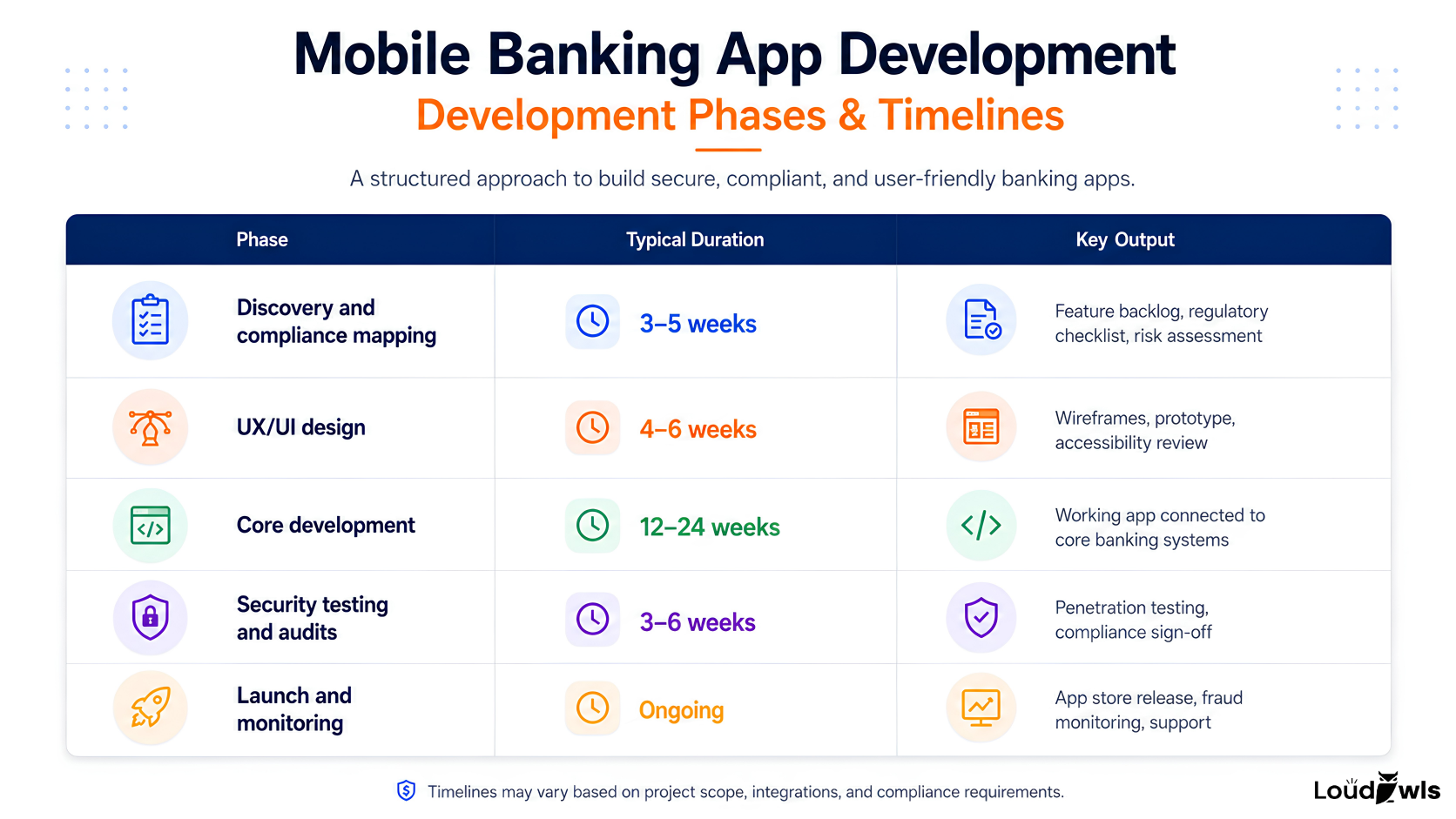
A lean MVP usually takes 4 to 6 months from finished requirements to launch. Want fraud tools and card controls too? Plan for 8 to 12 months, sometimes longer with heavy legacy integration.
Compliance mapping needs to happen during discovery, not after development starts. Wait too long, and you'll end up rebuilding data flows that were never designed to be audited or exported cleanly.
Security testing also takes longer here than in most app categories. Penetration testing and compliance sign-off aren't steps you can rush just to hit a launch date.
Core development itself often runs longer than founders expect, mostly because of core-banking integration work. Legacy banking systems weren't built with modern APIs in mind, and bridging that gap takes care, not speed.
What Compliance and Security Rules Apply to a Banking App?
Any banking app handling account access has to follow federal guidance on authentication. The FFIEC's 2021 guidance calls for layered security and treats single-factor login as insufficient for sensitive actions.
Apps offering mobile check deposit fall under the Check Clearing for the 21st Century Act. The Federal Reserve confirms this took effect in 2004, giving banks the legal basis to accept a check image instead of the paper original.
Any app touching card data also needs to meet PCI DSS, the payment card industry's security standard. Most banks layer the Gramm-Leach-Bliley Act's privacy rules on top of that for customer financial data.
None of this is optional, and it isn't something you bolt on right before launch. Building compliance into the architecture from day one costs far less than retrofitting it after an examiner flags a gap.
Documentation matters as much as the controls themselves. Examiners want to see that authentication decisions and data-handling choices were made on purpose, not thrown together under deadline pressure.
State-level rules add another layer worth planning for early. Money transmitter licensing requirements vary by state, and a fintech operating nationally may need to track obligations across dozens of jurisdictions, not just one federal framework.
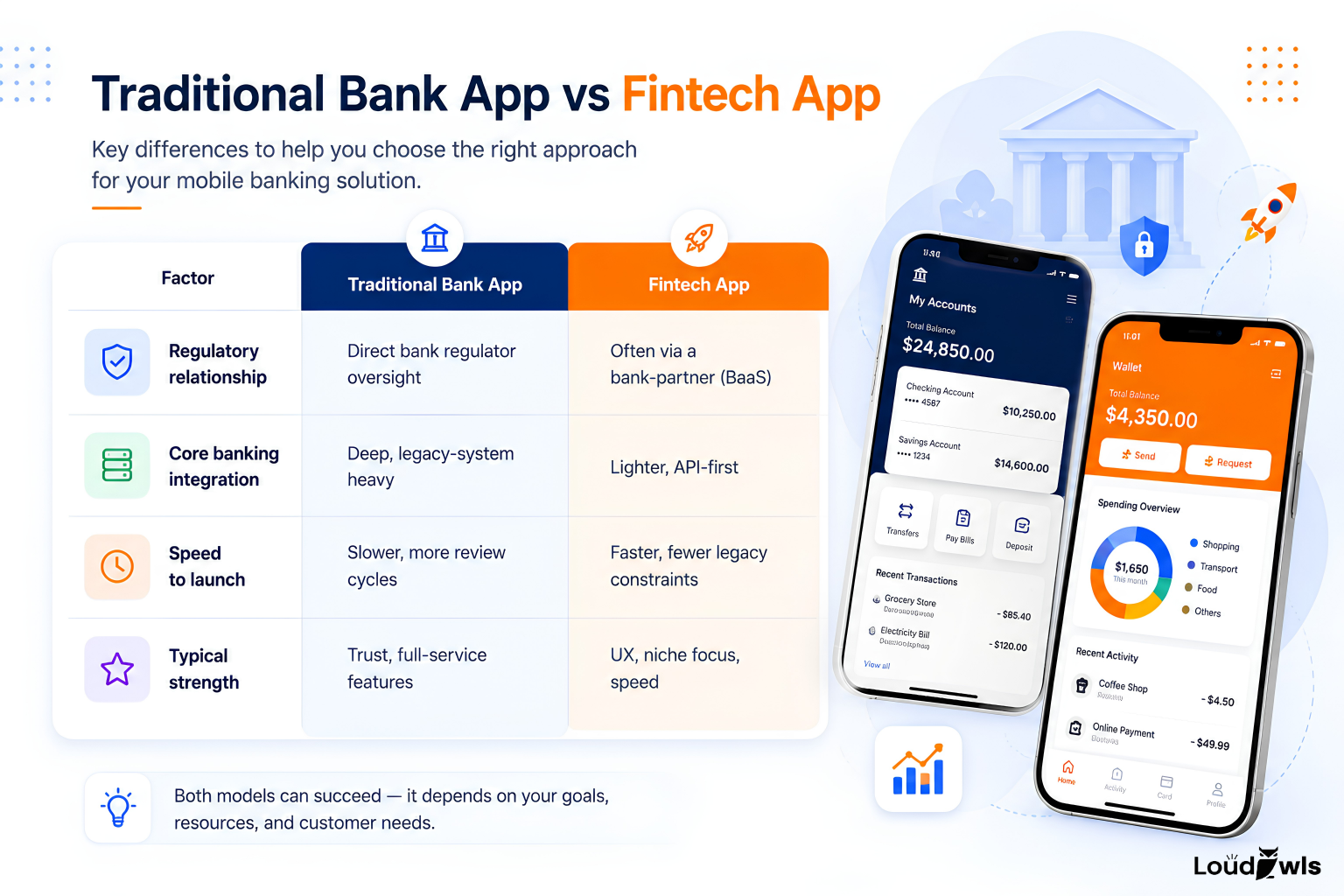
Fintech App Development vs Traditional Banking App Development: What's the Difference?
Both approaches solve overlapping problems, just inside different regulatory worlds. A fintech usually partners with a bank behind the scenes. A bank's own app answers directly to its own regulators.
Neither path wins automatically. A bank building its own app gets more control, but moves slower.
A fintech gets speed, but leans hard on its banking partner's stability and terms. That's worth weighing carefully before you commit to an architecture.
This one decision shapes almost everything after it: which vendors you can use, how long compliance review takes, and how much of the core banking stack you actually need to touch.
In-House Team, Agency, or Banking-as-a-Service Platform?
The right build path comes down to how much banking infrastructure you want to own versus rent from a partner.
In-house team. Works well for banks and credit unions with existing compliance staff and a long runway. Slowest to get moving, but cheapest to run once it's established.
Development agency. A good fit for teams that need this expertise fast, without hiring a compliance-savvy team from scratch.
Banking-as-a-service platform. Makes sense for fintechs that want to launch fast by renting a partner bank's charter and infrastructure, instead of becoming a bank themselves.
Picking a BaaS platform early, then realising later you need deeper core-banking control, is one of the more expensive pivots in this whole category.
Talk to your compliance counsel before locking in a path, not after. A platform choice made purely on speed can limit which products you're allowed to offer down the road.
What Mistakes Sink Banking App Projects?
The most common mistake? Treating compliance like a post-launch task. Regulators expect it baked into the architecture from day one, not patched in after the app's already live. Another big mistake is underestimating support and fraud operations. A banking app generates disputes, fraud claims, and account lockouts from day one.
Someone has to handle all three at real scale, and that operational cost rarely shows up in the initial project budget. Teams also love to copy a large bank's full feature list before proving a smaller, focused version even works. A lean MVP that nails transfers and mobile check deposit beats a bloated app that does everything poorly.
Skipping real penetration testing to hit a launch date is a mistake that tends to surface publicly later, usually at the worst possible time for the business. Founders often underestimate how much ongoing work compliance monitoring really is. It isn't a one-time audit. It's a standing job for as long as the app exists.
One more mistake worth naming: launching without a plan for what happens when core banking systems go down. Even a short outage erodes trust faster in a banking app than in almost any other category. A visible status page and honest in-app messaging matter more here than usual. People forgive an outage. They don't forgive silence during one.
Frequently Asked Questions
How much does mobile banking app development cost?
Mobile banking app development usually costs $90,000 to $300,000 in the US, with a full two-platform build averaging around $287,000. Compliance scope and core-banking integration drive most of that swing.
How long does banking app development take?
A lean MVP takes 4 to 6 months. Want fraud detection and card controls too? Plan for 8 to 12 months, with security testing adding real time near the end.
What's the difference between fintech app development and building a bank's own app?
Fintech app development usually means partnering with a bank behind the scenes and moving faster, with fewer legacy systems to deal with. A bank's own app answers directly to regulators and comes with deeper core-banking integration.
Is a mobile check deposit app hard to build?
Mobile check deposit is a well-established feature, but it still needs Check 21 compliance, fraud detection, and a reliable image-capture flow. That adds real development time beyond just the camera screen.
Do I need a bank charter to build a digital banking app?
No. Banking-as-a-service platforms let fintechs launch a digital banking app development project by partnering with a chartered bank, without becoming a bank themselves.
Build Your Mobile Banking App With LoudOwls
LoudOwls works with US banks, credit unions, and fintechs on secure, compliant digital banking projects, from compliance-aware discovery through launch and post-launch monitoring.
With a decade of experience in global talent acquisition and HR leadership, Niti Aggarwal has helped build high-performing technology teams across India, Singapore, and LATAM. At LoudOwls, she focuses on people strategy, culture