How to Build an App Like Noom: Features, Cost, and Tech Stack for 2026
BG green: Quick Summary
Noom is a behavioural-science weight loss app built on cognitive behavioural therapy. It's not a calorie tracker with coaching bolted on.
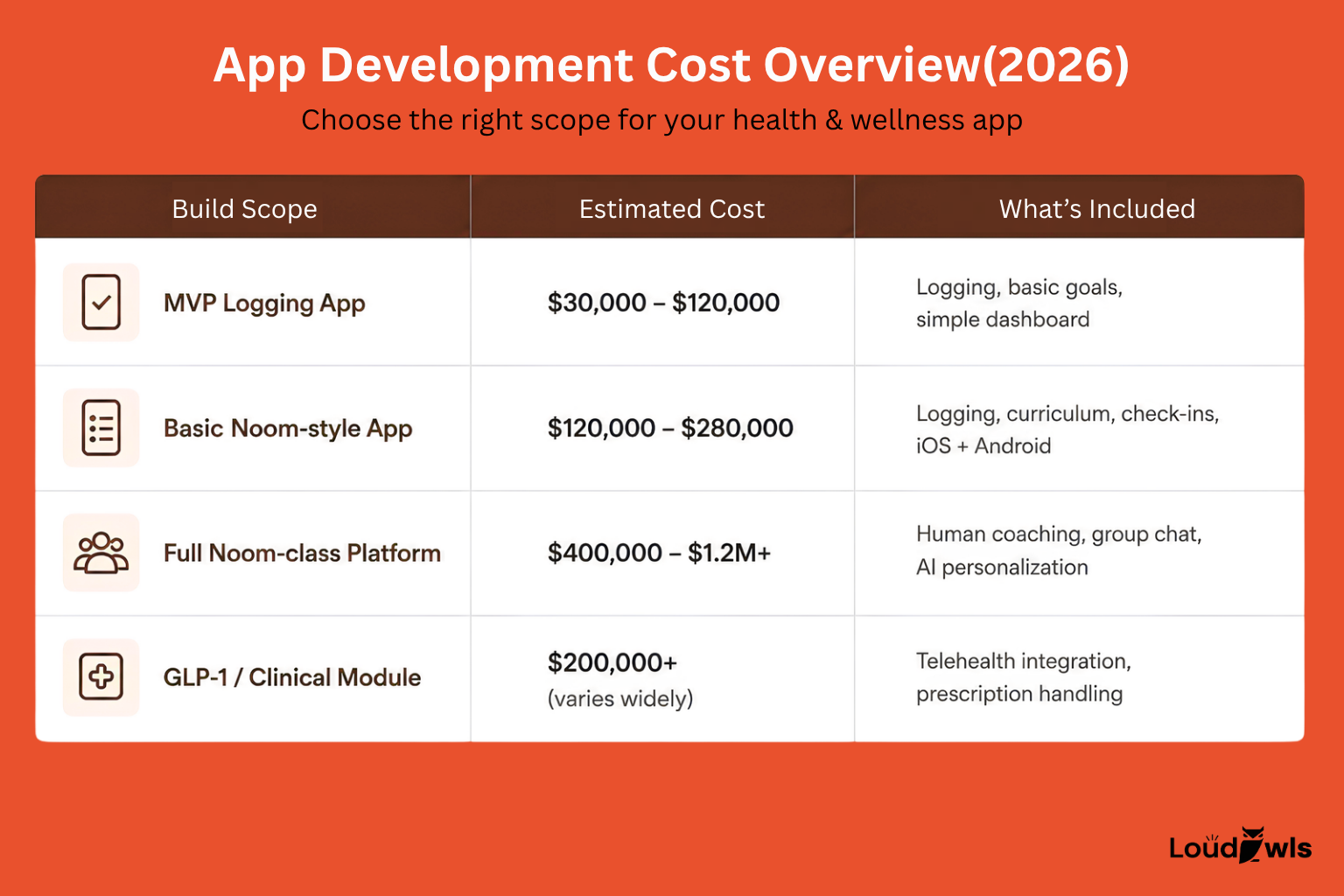
A basic app like Noom, covering food logging, curriculum, and check-ins, costs roughly $120,000 to $280,000 to build.
A full Noom-class platform with human coaches and AI personalisation runs $400,000 to $1.2 million or more.
Subscription is the dominant monetisation model in this corner of fitness app development. Noom-class apps are priced around $70 a month, dropping to roughly $17–$20 a month on annual plans, perNoom's own pricing page.
Most weight loss and fitness apps aren't HIPAA-covered entities. Many fall under the FTC's Health Breach Notification Rule instead, depending on how they handle health data.
What Is Noom, and Why Do Founders Want to Build Something Like It?
Noom is a subscription coaching platform founded back in 2008. It pairs a cognitive behavioural therapy curriculum with food logging and human coaching to drive real habit change. The mobile app launched in 2016, and its programs have since grown to cover stress management and general wellness too.
Founders want to build an app like Noom because the category proved a point plain logging tools never could: people will pay recurring subscriptions for structured accountability, not just a place to record meals. Noom's colour-coded food system, daily 10-minute lessons, and one-on-one coaching carved out a niche that a bare-bones logging tool can't easily copy.
A simple logging tool is a straightforward build. A coaching platform people stay subscribed to for nine months needs a lot more — a content and coaching strategy behind it, not just a logging screen. This guide walks through the features, tech stack, cost ranges, monetisation choices, and compliance requirements for building this kind of platform in 2026.
Who Actually Uses a Noom-Style App?
Understanding the user comes before any feature list. Build for the wrong person, and even a well-coded app underperforms.
Noom's core users have usually tried calorie counting already and quit. They're not looking for another one of the generic nutrition tracking apps with a nicer interface — they're adults, often 30 to 55, who want structure and accountability more than raw data. Many have tried multiple diets before, and what they respond to is a coach checking in, not just a streak counter.
Knowing exactly who you're building for changes your feature priorities early. Users chasing GLP-1 support need a different onboarding path than users focused purely on behaviour change.
What Features Do You Need to Build a Noom-Style Coaching Platform?
A competitive coaching platform needs five feature layers working together: onboarding, tracking, curriculum, coaching, and progress visibility. Skip any one of them, and the product slides back into a plain logging tool.
Smart onboarding and goal setting. A quiz-driven intake should capture weight history, activity level, and behavioural patterns, not just height and weight. This sets the personalisation engine up right from day one.
Food and activity logging. Every other feature depends on this data layer. A simplified system, like colour-coded categories instead of precise macros, lowers the effort it takes to log every day. Teams building a straight nutrition plan app often underestimate how much this one screen shapes daily retention.
Behavioural curriculum. Short daily lessons built around CBT principles, delivered as articles and quizzes, are what separate a nutrition plan app from a genuine behaviour-change product.
Human or AI coaching. Real-time or asynchronous coaching through in-app messaging drives retention harder than any single tracking feature. Many teams start with AI coaching and add human coaches once volume justifies the cost.
Progress dashboards and social accountability. Weight trends, streaks, and optional group support keep users engaged between coaching sessions, giving the app a reason to open daily rather than weekly.
Noom-Style Coaching Apps vs. Basic Logging Tools: What's the Real Difference?
A diet tracker app logs calories and macros. A Noom-style app changes behaviour around why someone eats the way they do — and that distinction shapes your entire cost and engineering plan, not just your marketing angle.
Nutrition tracking apps like MyFitnessPal or Cronometer compete on database size and logging accuracy. Their users want precision, not psychology, and they get frustrated by apps that ask them to read a lesson before logging lunch.
Noom's audience looks different. Its strongest users already tried calorie counting and quit, so they respond better to a coach and a curriculum than a macro breakdown. A precision-first logging tool needs a bigger food database and barcode scanning. A behaviour-first coaching platform needs stronger content, coaching workflows, and habit-tracking logic instead.
How Does Noom Stack Up Against Its Closest US Competitors?
Noom isn't the only player worth studying before you scope a build. A few names come up again and again in the US market.
Weight Watchers (WW) leans on a points-based food system and community workshops, both in-person and virtual. It's the closest thing to Noom in scale, but its differentiator is group accountability, not one-on-one psychology.
Calibrate and Found both position themselves as clinician-led programs, pairing GLP-1 prescriptions with coaching. They compete less on habit-change content and more on medical oversight, which shapes their entire compliance posture.
MyFitnessPal sits at the opposite end. It's a pure tracking tool with a large food database and no behavioural curriculum layered on top.
The lesson for founders: decide early which lane you're building in. A CBT-first app like Noom, a clinician-led GLP-1 platform like Calibrate, or a tracking tool like MyFitnessPal all require different teams, different compliance work, and different cost profiles. Trying to be all three at once is usually where budgets and timelines fall apart.
What Tech Stack Powers an App Like Noom?
Many of the same building blocks used for plain nutrition tracking apps carry over here, though AI and coaching make the architecture more complex. Most teams work off a cross-platform framework, a Python or Node backend, and a separate AI layer for personalisation.
Flutter and React Native are the two dominant cross-platform choices, and both cut fitness app development time compared with maintaining two native codebases in parallel. On the backend, Python frameworks like Django or Flask pair well with AI/ML libraries such as TensorFlow or PyTorch, which handle coaching recommendations and food-image recognition.
Firebase or AWS typically handles authentication, push notifications, and file storage. A separate service manages HIPAA-adjacent data if your app touches telehealth or prescriptions.
Wearable integration, through Apple HealthKit and Google Fit, is close to table stakes now. Users expect step counts and workouts to sync automatically rather than requiring manual entry, and getting this layer right is one of the trickier parts of the build, since two hardware ecosystems have to behave consistently.
How Much Does It Cost to Build an app like Noom?
A basic coaching platform, with food logging, a content library, and check-ins, costs $120,000 to $280,000 for iOS, Android, and backend combined. A full Noom-class platform runs $400,000 to $1.2 million or more, and that includes human coaches, group chat, a complete behavioural curriculum, and AI personalisation. The gap comes mostly from coaching infrastructure and content, not app screens.
Adding GLP-1 medication integration typically adds a further six figures on top of either tier. The exact number swings widely, depending on which telehealth partner you integrate, how much compliance review is involved, and whether you're building custom infrastructure or plugging into an existing API. Treat any single GLP-1 figure as a rough planning estimate, not a quote.
These ranges assume a US-based or blended team. Working with an offshore development team can lower the build cost, but coaching operations and content still need US-based clinical and behavioural expertise, regardless of where the code is written.
What Team Do You Actually Need to Build This?
Cost estimates only make sense once you know who's on the team, and a Noom-class build isn't just engineers.
You'll need a product manager to own scope and keep coaching, content, and engineering timelines aligned, plus a UX/UI designer, since onboarding quality directly affects conversion and day-one retention. On the engineering side, expect two to four mobile engineers (or one Flutter/React Native team), plus a backend engineer for APIs and data. An ML engineer becomes necessary once you move past rule-based coaching into real personalisation.
You'll also need a behavioural content lead, often a registered dietitian or CBT-trained writer, to build the curriculum itself. QA and a compliance consultant round out the core team, especially once telehealth or GLP-1 features enter scope. Smaller teams can combine roles early on. By the time you're at full Noom-class scope, most of these become dedicated positions.
How Does the Development Process Actually Unfold?
Most Noom-style builds move through five overlapping phases rather than one straight line. Discovery comes first: defining your target user, core differentiator, and MVP feature set before any code gets written. Design follows, focused heavily on the onboarding quiz and daily-use screens, since those drive the most engagement.
Engineering then builds the app in parallel with content production, not after it, since curriculum writing can't wait for a finished backend. QA and compliance review happen continuously, not as a final gate before launch. A soft launch to a small user group typically comes next, letting you catch onboarding drop-off before a full release.
Public launch and iteration follow, with coaching cadence and content refreshed based on real retention data. Skipping the soft-launch step is a common shortcut that ends up costing more in post-launch fixes than it saves in time.
What Monetisation Model Should You Use for a Coaching Platform?
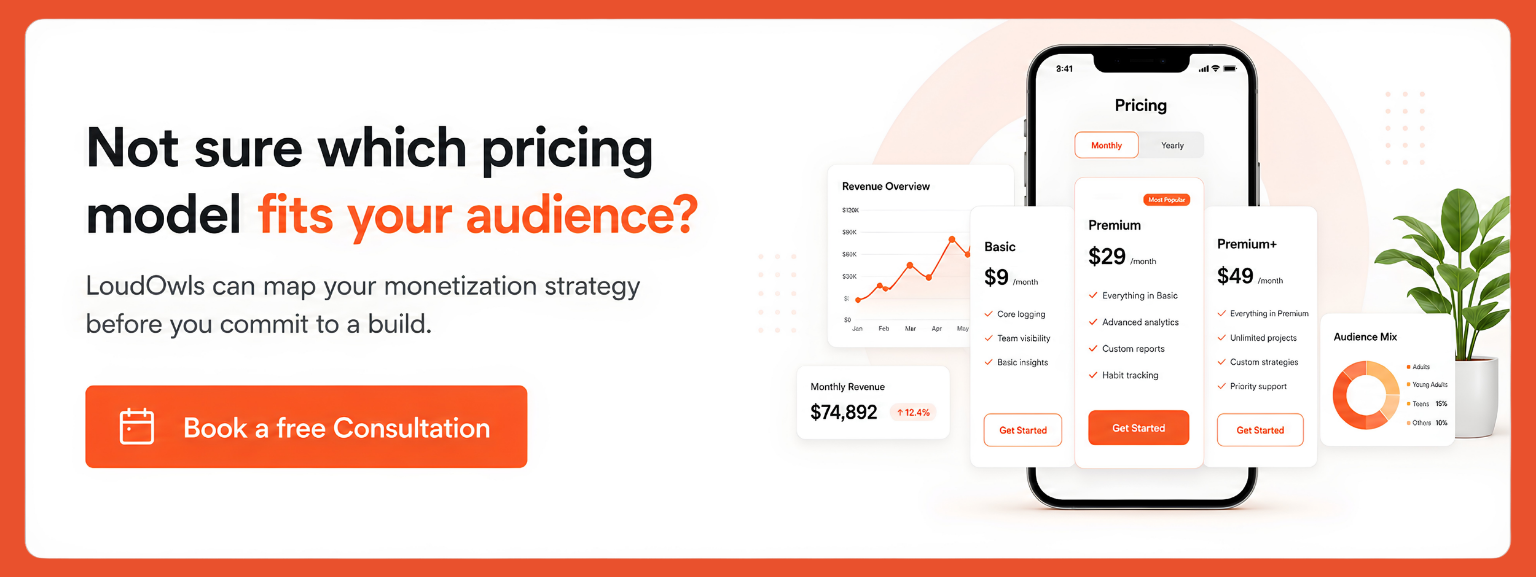
Subscription is the dominant monetisation model for this category. Noom-class pricing runs around $70 a month, dropping to roughly $17–$20 a month on an annual plan, based on Noom's currently published pricing. Longer-term plans, paid four or eight months upfront, improve cash flow and reduce churn compared with month-to-month billing, which is why most competitors push multi-month commitments hard at signup.
A freemium tier, basic tracking free with coaching and curriculum behind a paywall, can widen your top of funnel, though it adds support and infrastructure costs that a pure-subscription model avoids.
B2B2C distribution is worth considering too. More employers now bundle wellness apps into benefits packages, giving coaching platforms a lower-churn, higher-value revenue channel outside direct consumer acquisition.
What Compliance and Regulatory Issues Apply to Coaching and Wellness Apps?
Most coaching and wellness apps aren't covered by HIPAA at all. HIPAA applies to healthcare providers, insurers, and their business associates, not consumer wellness apps generally. Many of them may fall under the FTC's Health Breach Notification Rule instead, depending on how the app collects, maintains, and shares health information.
A 2024 amendment confirmed the rule applies to a broad range of health apps and similar technologies. It requires notice to users, the FTC, and sometimes the media after a breach of unsecured health data, per the FTC's own guidance.
If your app integrates telehealth or prescription handling for GLP-1 medications, HIPAA obligations become more likely to apply, though whether they actually do depends on how the service is structured and which entities are involved. This is worth confirming with a healthcare compliance attorney before scoping the build, not assuming from the feature list alone.
The FTC also scrutinizes health claims in your own marketing. Copy that implies guaranteed weight loss results, without substantiation, is a common enforcement target, so legal review belongs on the launch checklist, not as an afterthought.
How Long Does It Take to Build a Noom-Style Platform?
An MVP logging tool with core tracking ships in three to four months for most teams. A basic Noom-style app, with curriculum and check-ins added, takes six to nine months. A full platform, with human coaching infrastructure, group features, and AI personalisation, runs nine to fourteen months in most cases, since coaching workflows and content production overlap with engineering rather than happen after it.
Content production is the timeline risk most teams underestimate. Fitness app development on this scale rarely finishes early, and a genuine CBT-based curriculum takes months to write and review properly. Rushing it can undermine the product's core value, and rushed timelines are also where build budgets tend to blow past their original estimate.
What Does It Cost to Maintain This After Launch?
Launch isn't the finish line. Coaching platforms need ongoing investment to keep users engaged past month one. A widely cited industry benchmark puts annual maintenance at 15% to 25% of the original build cost, covering bug fixes, security patches, and OS updates.
Content is a separate, recurring line item, since a CBT curriculum needs refreshing every few months to stay relevant and avoid feeling repetitive. Coaching operations scale with your user base too — more subscribers means more coaches, which is a headcount cost, not just a software one. Wearable integrations also need regular upkeep, since Apple HealthKit and Google Fit both push periodic API changes.
Founders who budget only for the initial build often get caught off guard by this ongoing cost a few months post-launch.
What Mistakes Do Founders Make When Building a Coaching Platform Like Noom?
The most common mistake is treating this as a tracking-app project instead of a content and coaching operation with an app attached. Coaching and content, not code, tend to be the bigger line item.
Underbudgeting content. A thin curriculum makes the app feel like a bare logging tool with extra steps, which undermines the premium pricing the behaviour-change pitch is supposed to justify.
Launching without a retention plan. This category sees steep drop-off after the first month. Coaching cadence and habit-tracking nudges need to be designed in from day one, not patched in after churn shows up.
Assuming HIPAA covers everything. Claiming blanket HIPAA compliance for a consumer wellness app that isn't a covered entity is inaccurate — and it's also a red flag to informed users and investors.
Skipping regulatory review on marketing claims. Overpromising results in app store copy or ads invites FTC scrutiny. A quick legal review would have caught it early.
Why Choose LoudOwls for Your Coaching App Build?
LoudOwls scopes coaching and content requirements alongside engineering from the start, which helps keep the estimate tied to the actual product scope, including content and coaching. The team breaks builds into phases: MVP, curriculum and coaching layer, then compliance review, so you can validate demand before committing to the full budget a Noom-class platform requires.
Compliance gets flagged early rather than left for launch week, including clarifying what does and doesn't fall under HIPAA versus the FTC's Health Breach Notification Rule for your specific feature set.
Frequently Asked Questions
How much does it cost to build an app like Noom?
A basic Noom-style app with food logging and a curriculum costs roughly $120,000 to $280,000. A full platform with coaching and AI personalisation runs $400,000 to $1.2 million or more.
What's the difference between a weight loss app and a diet tracker app?
A diet tracker app logs food and calories. A weight loss app in the Noom mould adds a behavioural curriculum and coaching designed to change habits long term.
Do coaching and wellness apps need to be HIPAA compliant?
Usually not directly, since most consumer wellness apps aren't HIPAA-covered entities. They typically fall under the FTC's Health Breach Notification Rule instead, unless they integrate telehealth or prescription features.
What's the best tech stack for a nutrition plan app in 2026?
Most teams use Flutter or React Native for cross-platform mobile development, a Python backend with Django or Flask, and TensorFlow or PyTorch for coaching logic.
Is subscription the best monetisation model for a coaching platform?
For Noom-class apps, yes. Noom's own published pricing shows a much lower effective monthly rate on longer, prepaid plans versus month-to-month billing. A freemium tier or B2B2C channel can widen distribution alongside it.
Building a Coaching Platform That Actually Retains Users
An app like Noom succeeds or fails on behaviour change, not feature count. The features, coaching model, and compliance choices above only work together if they're planned as one product, not bolted together after launch.
Budget for the full build, curriculum, coaching infrastructure, and compliance review before you commit to a launch date. Cutting any one of those to hit a deadline shows up in churn within the first month.
With a decade of experience in global talent acquisition and HR leadership, Niti Aggarwal has helped build high-performing technology teams across India, Singapore, and LATAM. At LoudOwls, she focuses on people strategy, culture