social commerce app
How to Build a Social Commerce App: Features, Costs and Development
Quick Summary * A social commerce app blends product discovery, social interac


QUICK SUMMARY
In a market where consumer expectations are high and competitor timelines are short, the cost to build an app in Dubai is only half the equation. The other half is the cost of building it wrong – late, underpowered, or architected in a way that creates a ceiling on your own growth.
Decision-makers who treat app development cost as a line item to minimize tend to discover the real cost later: in technical debt, in re-platforming projects, in user churn from an experience that was never built to handle scale. Whether you're evaluating Android app development cost, iOS app development cost, or a cross-platform build, the variables change — but the principle doesn't. Your app development budget isn't just a spend decision; it's a product strategy decision.
In this blog, we walk through the real cost drivers behind mobile app development in Dubai, platform architecture, feature complexity, team composition, regulatory considerations, and the post-launch financial commitments that most initial quotes quietly omit. For anyone building a credible investment case around a custom app development engagement, the detail that follows is where that case gets built.

Mobile App development cost in Dubai doesn't follow a single scale; it follows a decision tree. Every branch you take adds or removes scope, and scope is what drives spend. Before any developer opens a code editor, you should be able to answer: what platform, what features, what scale, and what timeline? The clearer those answers, the more accurate your estimate.
App Development Cost by Complexity:
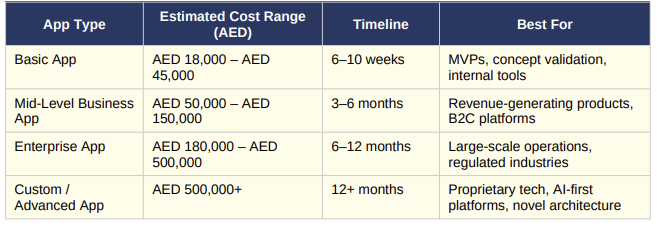
Basic doesn't mean bad; it means focused. These are apps with a defined, single-purpose function: a booking flow, a directory, an internal operations tool. The architecture is straightforward, the UI relies heavily on existing component libraries, and the backend is minimal.
At this tier, mobile app development cost in Dubai typically falls between AED 18,000 and AED 45,000, depending on design complexity and the number of core screens. REAL-WORLD EXAMPLE: A Dubai-based logistics startup built a basic driver-tracking MVP for field operations at approximately AED 35,000 — single platform, minimal UI, core tracking functionality only. It validated the concept in eight weeks before the team committed to a full build.
This is the category most serious products fall into. When people talk about mobile app development cost, they're usually, whether they realize it or not, describing a mid-tier build. These apps have real functionality, real users, and real backend complexity.
Mobile app development cost at this tier runs AED 50,000 to AED 150,000, with cross-platform builds generally sitting in the lower half of that range and dual-native builds in the upper half. REAL-WORLD EXAMPLE: A UAE-based on-demand home services platform — covering booking, vendor management, and payment processing — was built at AED 110,000 over four months using a cross-platform Flutter framework.
Enterprise apps are less about features and more about architecture. These are platforms built to serve large, distributed teams, or to process volumes of transactions and data that would break a mid-tier backend in weeks.
Enterprise-tier mobile app development cost in Dubai starts at AED 180,000 and scales with integration complexity, compliance requirements, and the number of concurrent user roles the system needs to support.
Custom means you're building something that doesn't have a template. Proprietary AI models, novel hardware integrations, blockchain infrastructure, or platforms with genuinely unique technical requirements – this is where custom app development cost is determined almost entirely by the specificity of what you're trying to create.
Custom app development cost in this category starts at AED 500,000 and is scoped on a project-by-project basis. R&D phases alone can represent a significant portion of total investment before a single production line is written.
Explore the step-by-step guide to building a successful mobile app development in this blog.
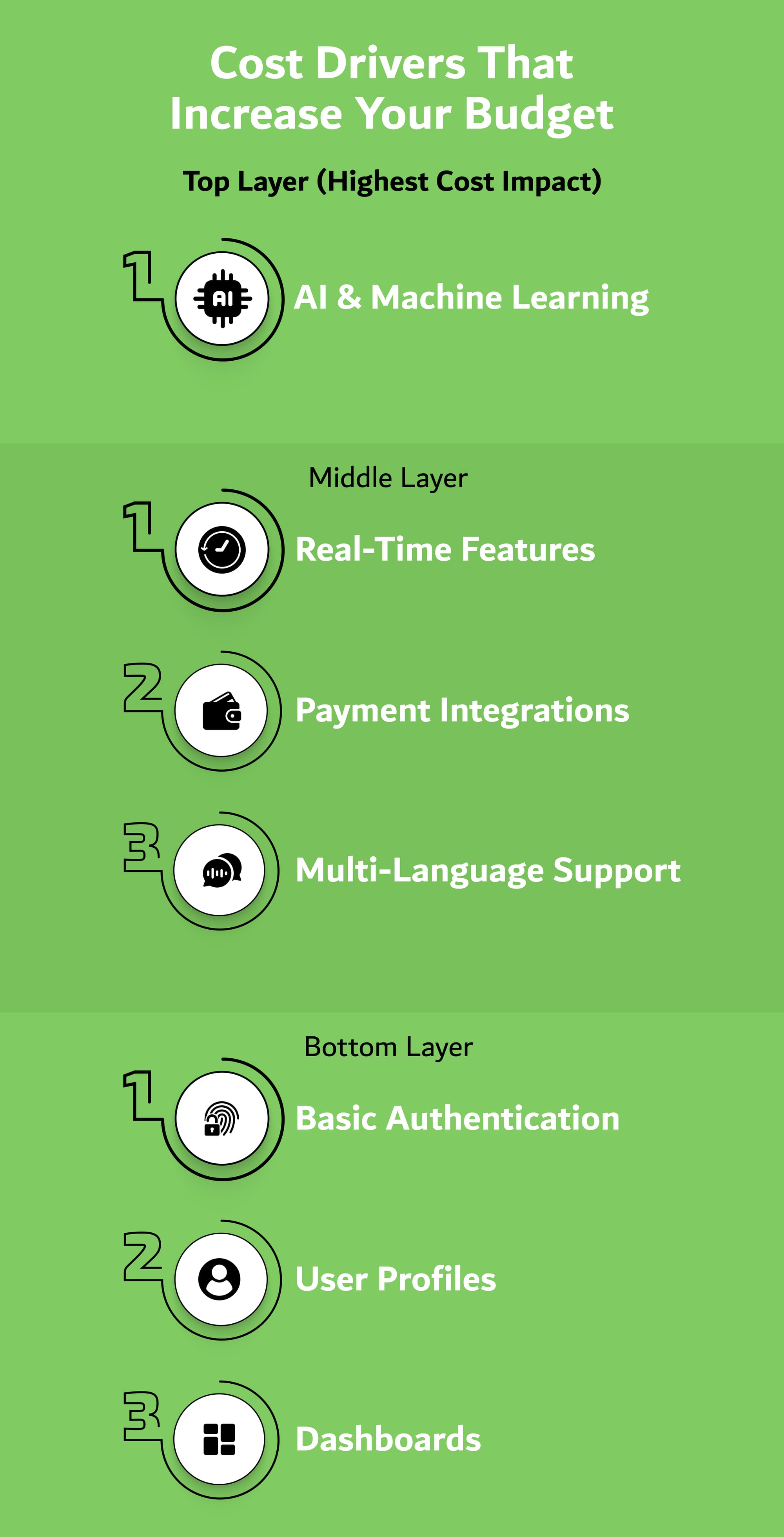
Two apps with identical feature lists can have genuinely different price tags. Here's why.
Complexity isn't additive; it compounds. A real-time matching system that also processes payments, maintains audit logs, and serves three different user roles isn't three features. It's dozens of engineering decisions, each of which creates dependencies that the next developer has to account for. When a scope document grows, so does the invisible logic underneath it.
Design is where app development in Dubai often gets underestimated. A template UI gets you to launch. A design built around real user research gets you to retention. In a market where app store competition is as high as it is in the UAE, the onboarding experience isn't cosmetic — it directly affects your day-30 retention rate. IDC's MEA Technology Investment Report 2026 notes that UX quality is now one of the top three factors influencing app adoption in the region.
Every integration you add to a scope document is a negotiation between your system and someone else's, with all the documentation gaps, rate limits, and version inconsistencies that entail. Payment gateways, KYC providers, mapping services, CRM platforms — none of them are plug-and-play in production.
In the UAE, regulatory frameworks are moving quickly. TDRA guidelines, ADGM financial regulations, and healthcare data standards all have technical implications that need to be designed in from day one. Retrofitting security architecture costs significantly more than building it correctly upfront, and the compliance risk of getting it wrong is substantially higher than the cost of getting it right.
Flutter, React Native, Swift, Kotlin; this decision affects developer availability, long-term maintainability, performance ceiling, and cost trajectory. The right stack is the one that fits your use case, user expectations, and team structure. Any agency that recommends a stack before understanding your product in detail is optimising for their own workflow, not yours.
Senior engineers write code that doesn't need to be rewritten six months later. The gap between a mid-level and senior developer isn't just speed; it's the architectural decisions made under pressure, and the edge cases caught before they become incidents. When evaluating app developers in Dubai, the total cost of engagement matters more than the day rate.
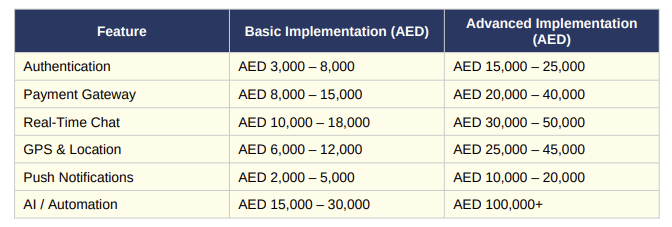
Features have individual cost profiles. Here's what drives them:
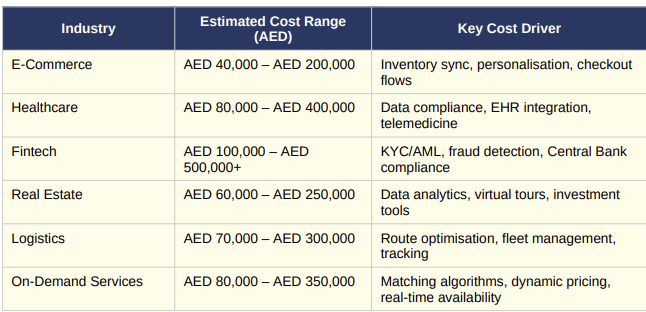
The vertical you're building shapes everything – regulatory requirements, feature complexity, user expectations, and integration scope.
Mobile App Development Cost by Industry

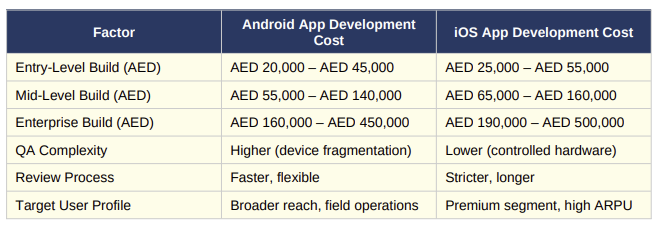
This is a market strategy question with a technical price tag attached to it.
Android commands a broader device reach and is dominant in markets adjacent to the UAE. The tradeoff: device fragmentation across manufacturers, screen sizes, and OS versions creates a QA surface area that iOS doesn't have. Android app development cost reflects that expanded testing scope.
iOS app development cost is slightly higher on average, driven by Swift's complexity, Apple's stricter review process, and the higher design expectations of iOS users. The return: iOS users in premium markets like Dubai consistently show higher engagement and monetisation metrics.
For B2C and fintech products targeting professional demographics in the UAE, start with iOS. For field operations, logistics, or mass-market consumer apps — Android or cross-platform. The answer isn't ideological; it's derived from your user data. If you don't have user data yet, that's what the MVP phase is for.
The build-vs-partner decision is more nuanced than most cost calculators suggest.
In-House Team vs Agency: Cost Comparison:
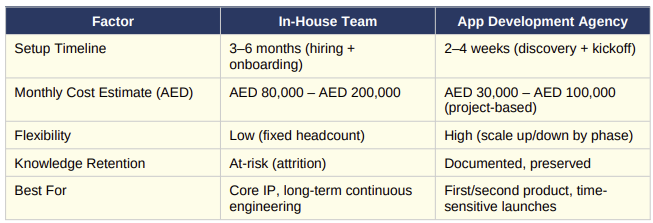
The fully-loaded cost of an in-house engineering team — salaries, benefits, hardware, workspace, recruitment fees, and onboarding time — is substantially higher than the base salary figures suggest. Add attrition risk, knowledge concentration in a small team, and the ramp time for new hires, and the cost picture gets more complex.
A product-focused app development company in Dubai gives you immediate access to cross-functional depth- product, design, engineering, and QA, without the overhead of employment. Scope-based or retainer models create budget predictability, and the institutional knowledge stays in the engagement, not in a single engineer's head.
For early-stage and mid-market businesses, agency partnership almost always wins on ROI, speed to market, and flexibility. In-house teams make sense when your software is your core competitive moat, and you need continuous, deep-cycle engineering. For most companies building their first or second product, that's not the situation they're in.
The build is never the final number. Budget for these from day one:
Spending efficiently isn't the same as spending less. It's spending on the right things in the right order.

LoudOwls works with founders and product teams who are building things with real commercial stakes. That means pushing back on the scope that doesn't serve your goals, not just building what's on the brief.
No black-box quotes. Every engagement starts with documented scoping, phased budget breakdowns, and explicit assumptions you can interrogate. You should be able to walk your investors through every line.
Platform recommendations come from your user data and business model — not from our preferred stack or internal team availability.
From discovery through post-launch engineering, one team holds context across the full lifecycle. No handoff gaps. No "that was the previous team's decision" conversations.
The market in Dubai isn't waiting. But building fast without building right is the most expensive path in the long run. The founders and investors who consistently win are the ones who treat cost clarity as a competitive advantage, before the first line of code.
Q: How long does mobile app development take in Dubai?
A: Timelines range from six weeks for a basic MVP to twelve months or more for enterprise platforms. Mid-level mobile app development in Dubai typically runs three to six months from a scoped brief to app store submission.
Q: Is it cheaper to build an Android or iOS app in Dubai?
A: Android app development cost tends to be marginally lower at the entry level, primarily because of Apple's stricter review requirements and Swift's steeper learning curve. However, the gap narrows at mid-tier and enterprise levels. Cross-platform development using Flutter or React Native is often the most cost-efficient path when both platforms are required.
Q: What is the highest hidden cost in app development?
A: Post-launch maintenance is consistently the most underestimated item in any app development budget. OS updates, security patches, performance monitoring, and bug resolution are ongoing costs that should be factored from day one, typically ten to twenty percent of the initial build cost annually.
Q: Can cross-platform apps match native performance?
A: For the majority of B2C use cases, yes. Frameworks like Flutter and React Native have matured to a point where performance differences are imperceptible to end users. Hardware-intensive applications- AR, advanced graphics processing, are the exceptions where native development remains the stronger choice.
Q: What does a fintech app cost to build in Dubai?
A: Fintech is one of the most complex and consequently most expensive verticals. Between KYC/AML compliance architecture, real-time fraud detection, secure transaction flows, and UAE Central Bank regulatory requirements, fintech mobile app development cost in Dubai typically starts at AED 100,000 and scales considerably from there, depending on the scope of financial services offered.

Quick Summary * A social commerce app blends product discovery, social interac
LoudOwls
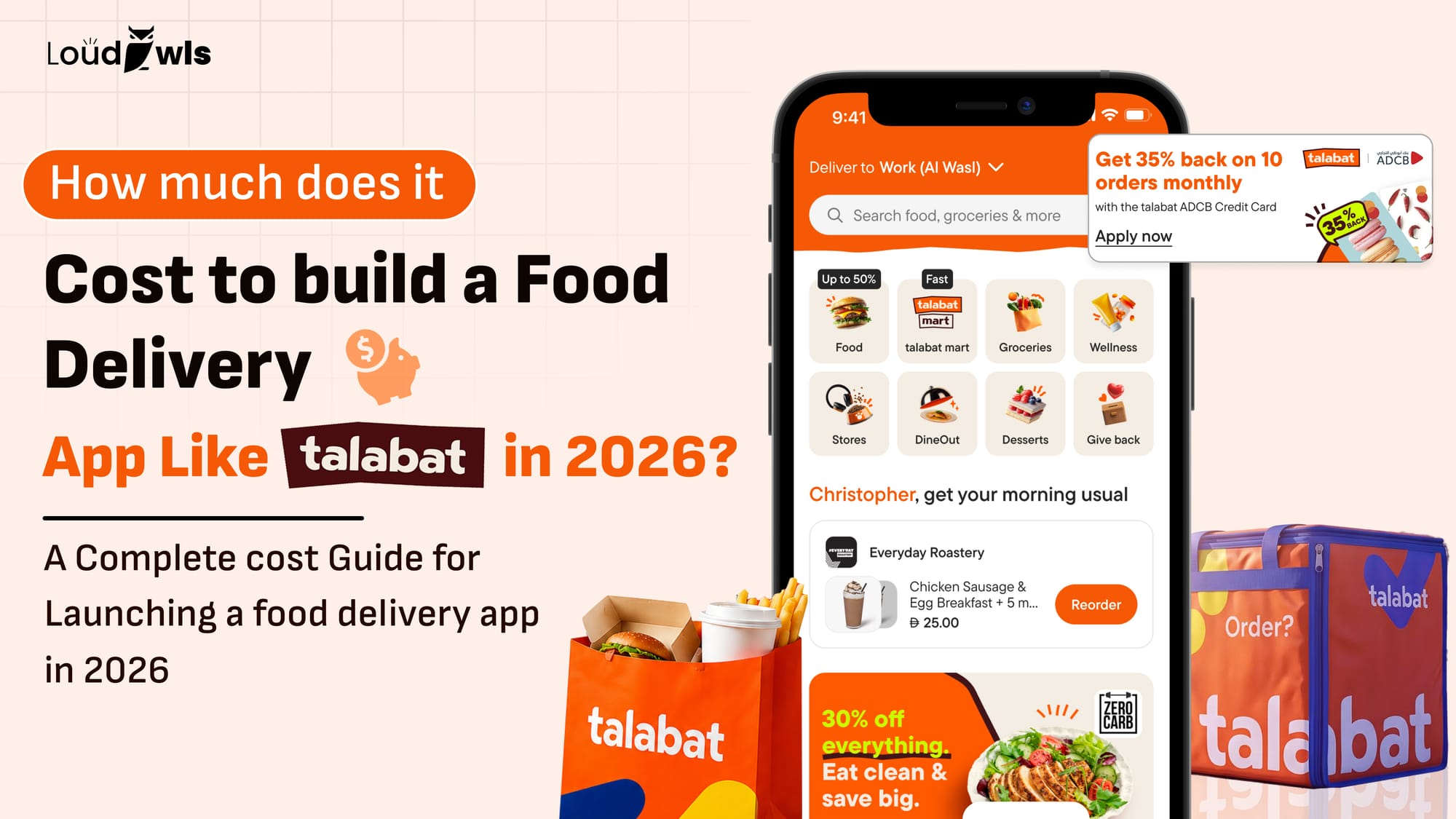
Quick Summary * Food delivery app development in 2026 ranges from roughly $20,
LoudOwls

Quick Summary * Building an AI app can cost anywhere from $15,000 to over $500
LoudOwls