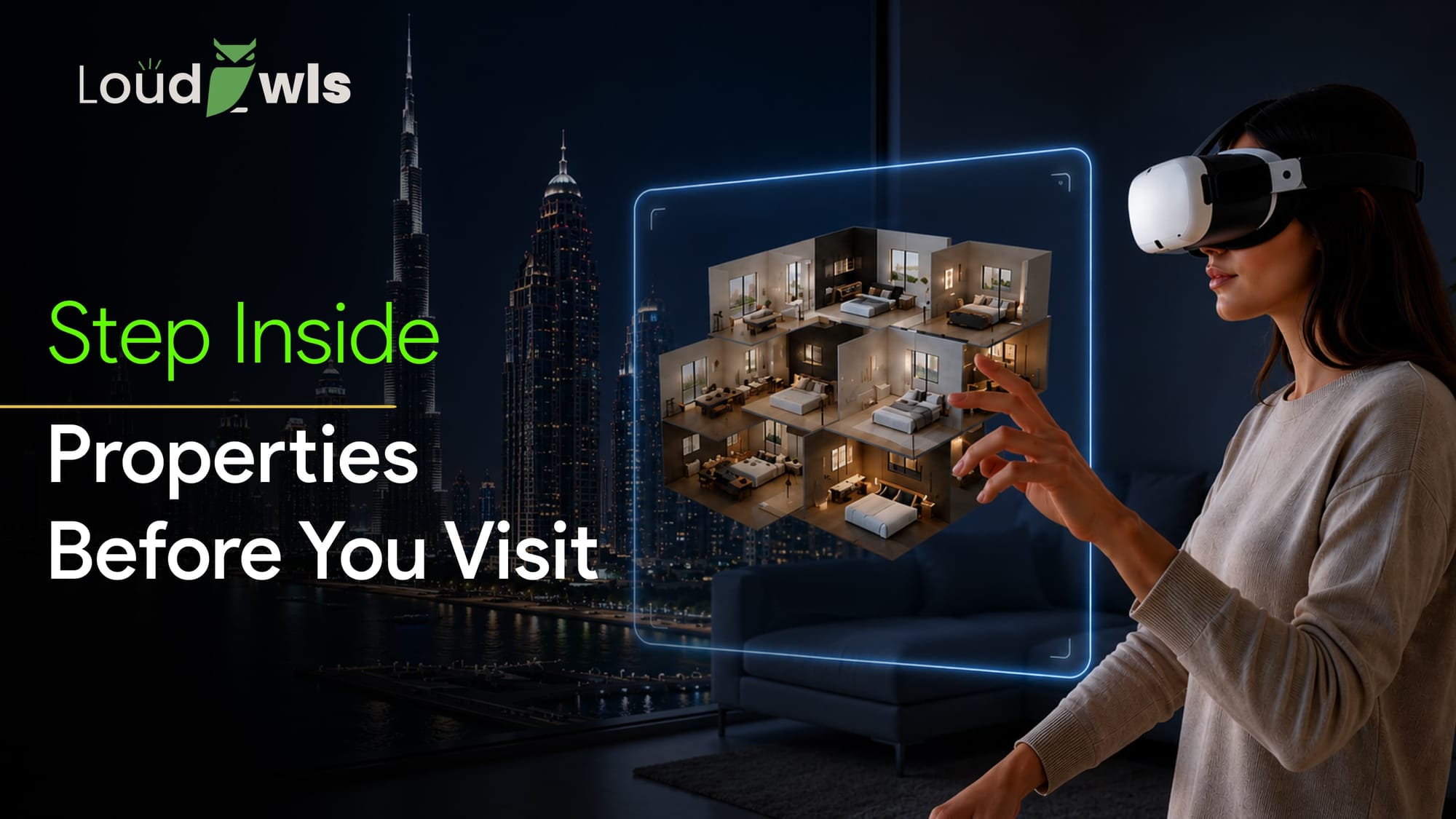
How Virtual Reality in Real Estate Is Transforming Property Tours in 2026
A Quick summary
Homebuyers in Dubai and Canada are no longer satisfied with photos and floor plans. They want to walk through the property before visiting it in person. This article covers how virtual property tours in Dubai and AR real estate platforms in Canada work, and what features buyers now expect.
Ready to give buyers the experience they actually want? LoudOwls builds custom VR and AR property tour apps for real estate developers and agencies in Dubai and Canada. If your listings still rely on photos, you are already behind. Schedule a meeting with the LoudOwls team to brainstorm the possibilities of a virtual tour platform in your portfolio.
Introduction
Goldman Sachs predicts that VR real estate will account for 2.8% of the total by year's end. That number is not being driven by technology companies. It is being driven by buyers who have decided that listing photos is not enough information to make a property decision.
Since 2023, developers in Dubai, such as DAMAC and Azizi, have been conducting pre-sales with VR showrooms. International buyers from India, the UK and Europe are buying off-plan homes in Dubai without visiting the site. In Canada, real estate websites are now offering 3D home walkthrough apps on listings. The expectations have changed. If it has no virtual tour, it's not worth viewing.
The expectation has shifted. If a listing does not have a virtual tour, many buyers scroll past it without a second look. Virtual property tours in Dubai and Canada have moved from a marketing extra to a baseline requirement.
What Buyers in Dubai and Canada Actually Want From a Virtual Tour
Not all virtual tours meet buyer expectations, and Simple 360-degree slideshows are increasingly less acceptable. In the current housing market, home buyers are going to view properties from a few different sources before contacting an agent, and they have expectations of what they should find.
Here's what buyers actively expect:
Full 360-degree tour real estate coverage of every room. Not just the living room and kitchen.
Interactive floor plan app integration so buyers can click a room on the plan and jump directly to that space
Support for viewing without a VR headset, which works on a phone.
Virtual staging real estate tools enable buyers to view the property with various styles of furnishings.
Agent or chatbot access during the tour to answer questions without leaving the experience
Pre-construction VR tour of Dubai’s capability for off-plan properties that do not physically exist yet.
MLS or CRM data integration for automatic listing updates
Analytics dashboard showing which rooms buyers spend the most time in
Buyers who are purchasing off-plan in Dubai from India or the UK cannot always travel to a showroom. The virtual tour is the showroom. That is a different demand from a Canadian buyer browsing local listings on their phone. But in both cases, the expectation for immersive, detailed, navigable content is the same.
AR vs VR in Property Tours: What Is the Difference
AR vs VR in Property Tours get used interchangeably, but they serve different purposes in real estate.
Feature
Virtual Reality (VR)
Augmented Reality (AR)
What it does
Fully replaces physical viewing with a digital environment
Overlays digital content onto the real world
Best used for
Pre-construction and remote property tours
On-site furniture placement and renovation previews
Device needed
VR headset or mobile app
Smartphone camera
Buyer use case
International buyers, off-plan sales
Local buyers customising a property
UAE adoption
High, DAMAC, Emaar, and Azizi are using it
Growing, used in showrooms and apps
Canada adoption
Active on MLS-linked portals
Used in renovation and staging apps
The practical difference matters when a developer is deciding which technology to invest in. VR is the right tool for pre-sales and international buyer outreach. For buyers who have reduced their short list, AR can be more useful to help individuals add a personal touch to what they are viewing.
How Virtual Staging Is Changing the Listing Experience
Empty properties are difficult to sell. That’s where virtual staging is making a difference. Virtual staging AI is used to digitally furnish an empty house. Rather than paying between $3,000 and $ 8,000 for actual physical staging, an agent would post images of an empty apartment, and the platform would furnish the rooms in the buyer's favoured style in a few hours.
This matters because 81 per cent of real estate agents confirmed in a National Association of Realtors study that staging helps buyers visualise a property as their future home. When that staging is digital, it costs a fraction of the cost of the physical alternative and can be customised for different buyer profiles instantly.
In Dubai, developers such as DAMAC are integrating personalisation of design in VR tours through AI. Home buyers can have interior themes, change flooring finishes, and look at kitchen layouts before they make a purchase decision on a property that is still being built. This is not experimental anymore. It is how high-volume off-plan developers are closing international sales in 2026.
In Canada, virtual staging is becoming a standard tool for agents relisting properties that expired without selling. A vacant home relisted with digitally staged photos and a 3D walkthrough consistently performs better than a bare relisting with new photos alone.
Immersive Property Tour Technology: What Is Built Into the Best Platforms
There’s a clear gap between a basic 360-degree photo tour and a proper immersive property tour technology platform. The most suitable platforms that have been implemented in the UAE and Canadian markets are:
AI-assisted navigation, which modifies the tour according to the areas the buyer spends the longest time.
Live video overlay so that an agent can be present in a VR tour and highlight features in real time.
Integrates digital twins into real estate 2026 new developments, providing buyers with a live-updating model of the development during construction.
Drone footage real estate listing integration to show the building, street, and neighbourhood before the buyer enters the virtual unit
Measurement tools so buyers can check whether their existing furniture will fit in specific rooms
How the Property Buying Journey Has Changed in Dubai and Canada
Buyers' search and short-listing process has undergone a significant transformation since 2022. Understanding this change helps explain why the technical requirements for virtual tours are now so specific.
The Dubai Off-Plan Buyer Journey
The Dubai international buyer buying off-plan in Dubai 2026 typically traverses a largely virtual journey, a path that is all but digital up until the transfer stage.
They start by searching on a portal like Property Finder, or Bayut,
and then they make a shortlist of properties that have virtual tours.
Then they book a video call with a developer agent, watch the VR walkthrough of the property during that call, and sign a reservation agreement without even coming to Dubai.
The physical handover visit is the one whose arrival is delayed, often years after the purchase decision, and is another form of virtual visit.
This is why developers like DAMAC and Emaar have invested so heavily in VR. For a property market where 45% of all residential purchases in 2024 came from foreign buyers, the quality of the virtual tour directly affects how much of that international demand a developer can capture.
The Canadian Buyer Journey
The Canadian route is different but the expectation for virtual content is similar. A Toronto or Vancouver buyer initiates their home search on the MLS Portal, narrows down the search results to find those with 3D tours, then makes multiple visits to the virtual home to pre-qualify the property before making a face-to-face appointment. Agents that don't use virtual tours are missing out because buyers ages 18 to 34 are 130% more likely to book an appointment to view a property after reviewing a 3D tour.
Common Mistakes Real Estate Businesses Make With Virtual Tours
Investing in virtual tour technology is only useful if the execution is right. Here are the most common errors that hinder a virtual tour platform:
Just covering the main areas, excluding bathrooms, storage and outdoor areas which raises questions for the buyer regarding what is not being covered.
Building a desktop-only experience when most buyers are browsing on mobile devices
Using low-resolution photos instead of proper 3D scans, which produces a flat experience that does not hold the buyer’s attention
Not updating pre-construction tours to reflect the progress of the building, results in outdated visuals for buyers.
Not including the virtual tour in the listing data (agent must manually update listing data and virtual tour)
Building a tour that requires a VR headset to function, which excludes the majority of potential buyers
The average project price of a custom VR property tour UAE platform is $12,000 for a single development tour experience and $45,000+ for a complete multi-listing platform featuring AR staging, agent overlay and digital twin integration. Typically, the timeline for building a timeline is from 6 to 16 weeks, depending on the number of properties and features they need.
How LoudOwls Builds Custom VR and AR Property Tour Apps
LoudOwls is a Dubai-based PropTech app development company that builds custom immersive property tour platforms for real estate developers, agencies, and portals across the UAE and Canada.
For developers selling off-plan units in Dubai, LoudOwls builds pre-construction VR tour experiences that update automatically as construction milestones are reached. For agencies in Canada working with MLS data feeds, the team builds 3D home walkthrough apps that pull listing data directly into the tour environment so there’s no manual content updates required.
Frequently Asked Questions
Q1. In terms of property tours, what are VR and AR?
VR replaces the physical environment with a fully digital one. The buyer views a complete virtual version of the property. AR overlays digital content onto the real world through a phone camera, used for things like placing furniture in a space or previewing a renovation finish.
Q2. Which UAE developers are selling properties before they are built using reality?
DAMAC, Emaar and Azizi are using reality to sell properties before construction starts. They allow foreign investors to inspect and/or buy empty land parcels. They let international buyers view and purchase properties that have not yet been built.
Q3. How long does it take to build a custom VR property tour UAE app?
Build timelines depend on the scope of the platform. A single-development VR tour with standard navigation and staging typically takes 6 to 8 weeks from brief to launch.
Q4. What is the price of a House Tour in 3D?
Costs vary depending on the type and scope of the experience. The cost is based on the type of virtual tour that is desired and can range anywhere from a $500 360 degree photo tour of one unit to $12,000 and above for a virtual tour that includes staging, live-agent overlay and floor plan integration.
Conclusion
The virtual property tours Dubai are no longer a “nice-to-have” feature. They have become a standard expectation in modern real estate markets like Dubai and Canada. Buyers now filter out listings that do not offer an immersive experience. For developers selling off-plan, VR is the sales tool that closes international buyers.
For agencies competing on portals, a 3D walkthrough is what separates a listing that gets clicked from one that gets skipped. The technology is available, the buyer’s appetite is clear, and the cost of building a proper virtual tour platform has come down significantly.
Have questions about virtual tours for your property listings? LoudOwls is here to help people who build and sell properties in Dubai and Canada and provide augmented reality solutions that really work. These virtual tours help attract serious buyers. If you are trying to sell a property that is not yet built, or if you want to improve your property listings, LoudOwls is here for you.
With a decade of experience in global talent acquisition and HR leadership, Niti Aggarwal has helped build high-performing technology teams across India, Singapore, and LATAM. At LoudOwls, she focuses on people strategy, culture, and building teams that support long-term growth. Her expertise spans global recruitment, tech hiring, people operations, and culture-first leadership, with experience hiring 300+ engineers, tech leads, and managers across specialized technology domains.
With 12+ years of experience in technology and product development, Pardip B has led 250+ projects across 20+ countries, working across fintech, healthcare, eCommerce, SaaS, education, real estate, and AI. His notable work includes Motus, Klink, Talez, Compass, and Pyxis Social, along with solutions for global organizations such as IBM and PNC. He combines full-stack engineering, mobile development, UI/UX, and product strategy to create scalable, intuitive, and high-performing digital experiences.