dating-app
Top 10 Dating Apps in the USA: The Complete 2026 Guide
QUICK SUMMARY: 1. This blog covers the ten leading dating apps operating in th

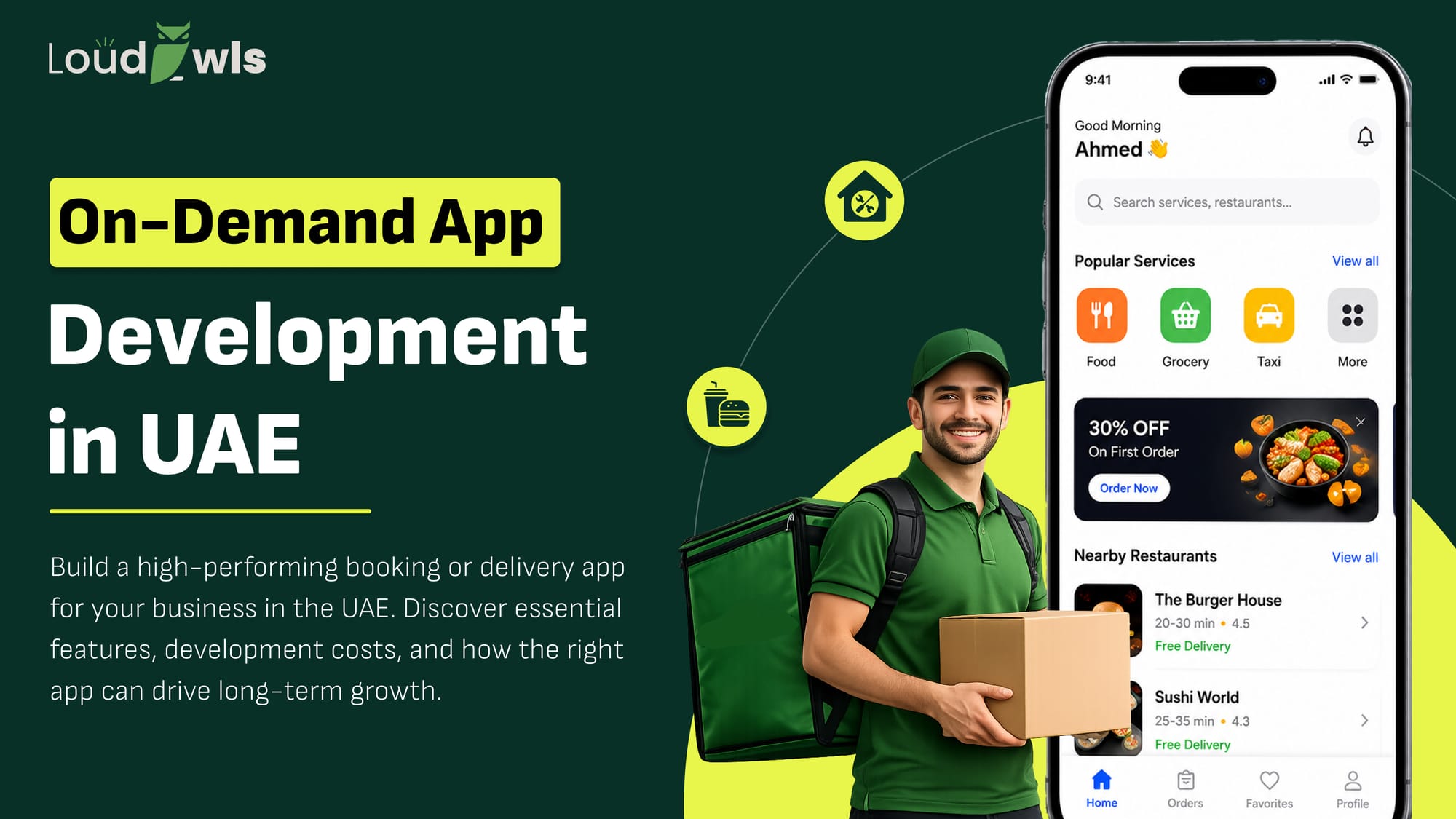

Quick Summary
A cleaning company in Al Barsha booked out its entire week before a single new customer ever called. No new hires, no extra marketing spend, just an app quietly taking bookings while the owner slept. That is the reality for a growing number of service businesses across the UAE right now, and it raises an obvious question: is it time your business built one too?
If you are weighing on-demand app development for your own business, you are probably trying to work out three things at once. What features actually matter, what it will realistically cost, and whether the return is worth the investment. Let us walk through all three honestly, without the usual sales pitch attached.
Dubai and Abu Dhabi have created a culture where instant service is the norm. Years of fast deliveries, ride bookings, and on-demand services have made speed an expectation rather than a competitive advantage.
As a result, businesses that once relied on phone calls or walk-ins are investing in their own apps rather than relying on third-party marketplaces. A dedicated app gives businesses greater control over customer relationships, valuable user data, and higher profit margins by reducing aggregator commissions.
The UAE's on-demand market is growing rapidly. By the end of 2026, the country is expected to have 10.8 million smartphone users (95% of the population). At the same time, sectors including home services, food delivery, quick commerce, and ride-hailing are seeing strong growth, creating significant opportunities for businesses investing in on-demand apps.
Companies like Careem and Talabat show what's possible. Careem has evolved into a regional super app with over 48 million users, while Talabat serves more than 6.5 million active customers in the UAE. Their success comes from making the app the core customer experience—not just another sales channel.
Several factors are driving the growth of on-demand apps in the UAE:
Cleaning, beauty, home repair, healthcare, logistics, and food are the categories moving quickest. In nearly all of them, a solid booking app or delivery app has stopped being an experiment and has become the primary way customers find and use the business.

Many on-demand apps fail because they overlook features that customers now expect as standard. Whether you're building a booking app or a delivery app, delivering a seamless user experience is essential.
Today, customers expect one-tap booking, real-time availability, live order tracking, flexible payment options, in-app communication, and instant notifications. These are no longer premium features—they're the foundation of a successful on-demand app.
On the provider or rider side, the app needs to make the job easier, not harder: fast job acceptance, sensible route optimization, a clear earnings view, and simple shift scheduling. If this half of the experience feels clunky, service quality suffers no matter how polished the customer app looks.
Then there is the admin panel. The admin panel is the backbone of an on-demand business, but it's often overlooked. It should provide live dashboards, analytics, order management, dynamic pricing, and dispute resolution tools to keep operations running smoothly. Investing in a strong admin panel from the start helps businesses scale efficiently, improve decision-making, and avoid operational challenges as order volumes grow.

Building an on-demand app is less complicated than it sounds once it is broken into stages. Here is what the journey usually looks like from idea to launch:
1. Discovery and planning: Define the business model, target users, and the core features that matter for launch. This stage sets the scope and, ultimately, the budget.
2. UI/UX design: Wireframes and visual design for the customer, provider, and admin experience, built around how UAE users actually behave rather than a generic template.
3. Development: Engineers build the customer app, provider app, and admin panel in parallel, wiring up payments, maps, and notifications along the way.
4. Testing and QA: Every booking flow, payment method, and edge case gets tested before real users touch it, including load testing for demand spikes.
5. Launch: The app goes live on the App Store and Google Play, with analytics in place to see how real customers use it.
6. Post-launch support: Bug fixes, performance monitoring, and the first round of feature updates based on real usage data.
Most MVPs move through these stages in eight to fourteen weeks. A full-featured platform typically takes four to six months.
Not every business needs an app, but a surprising number of UAE service businesses are strong candidates. If your business fits any of these categories, it is worth serious consideration:
• Cleaning and home maintenance companies booking recurring or one-off jobs
• Salons, spas, and beauty professionals offering at-home or in-studio appointments
• Healthcare providers offering home nursing, physiotherapy, or lab sample collection
• Laundry and dry-cleaning services with pickup and delivery
• Food and grocery businesses, including cloud kitchens and speciality grocers
• Logistics and courier companies handling last-mile delivery
• Fitness and wellness businesses offering personal training or class bookings
• Pet care providers offering grooming, walking, or at-home veterinary visits
The common thread: any business where customers currently book by phone call or WhatsApp message is a candidate for an app that removes the friction and captures the data behind every job.
Cost is often the first question businesses ask, but there is no fixed price for on-demand app development. The final cost depends on your business requirements, features, and the overall project scope.
Key factors that influence development cost include the choice between native and cross-platform development, the need for separate customer, provider, and admin apps, and advanced features such as live tracking, in-app chat, dynamic pricing, and third-party integrations like payment gateways and maps.
Here is what actually moves the number up or down:
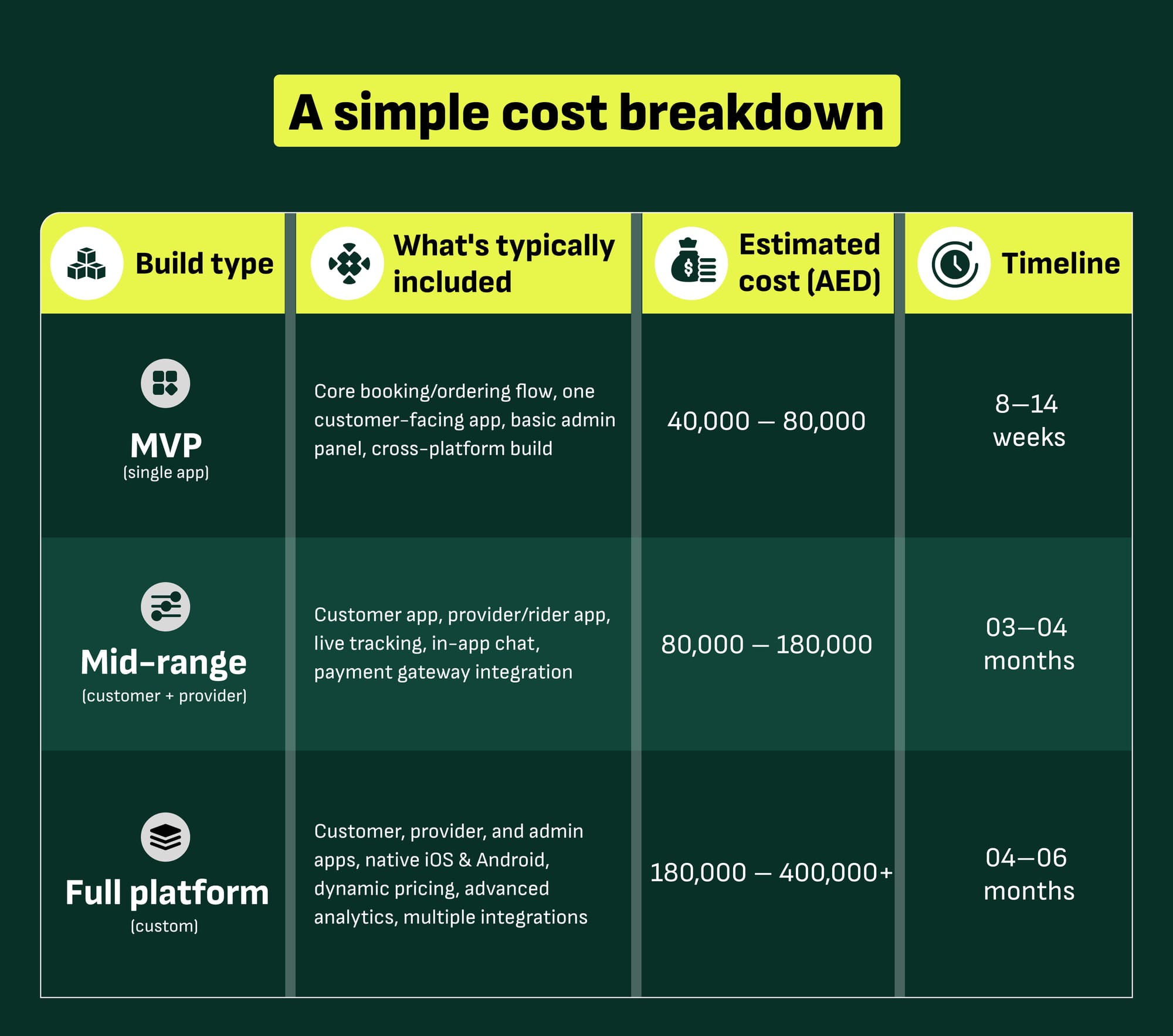
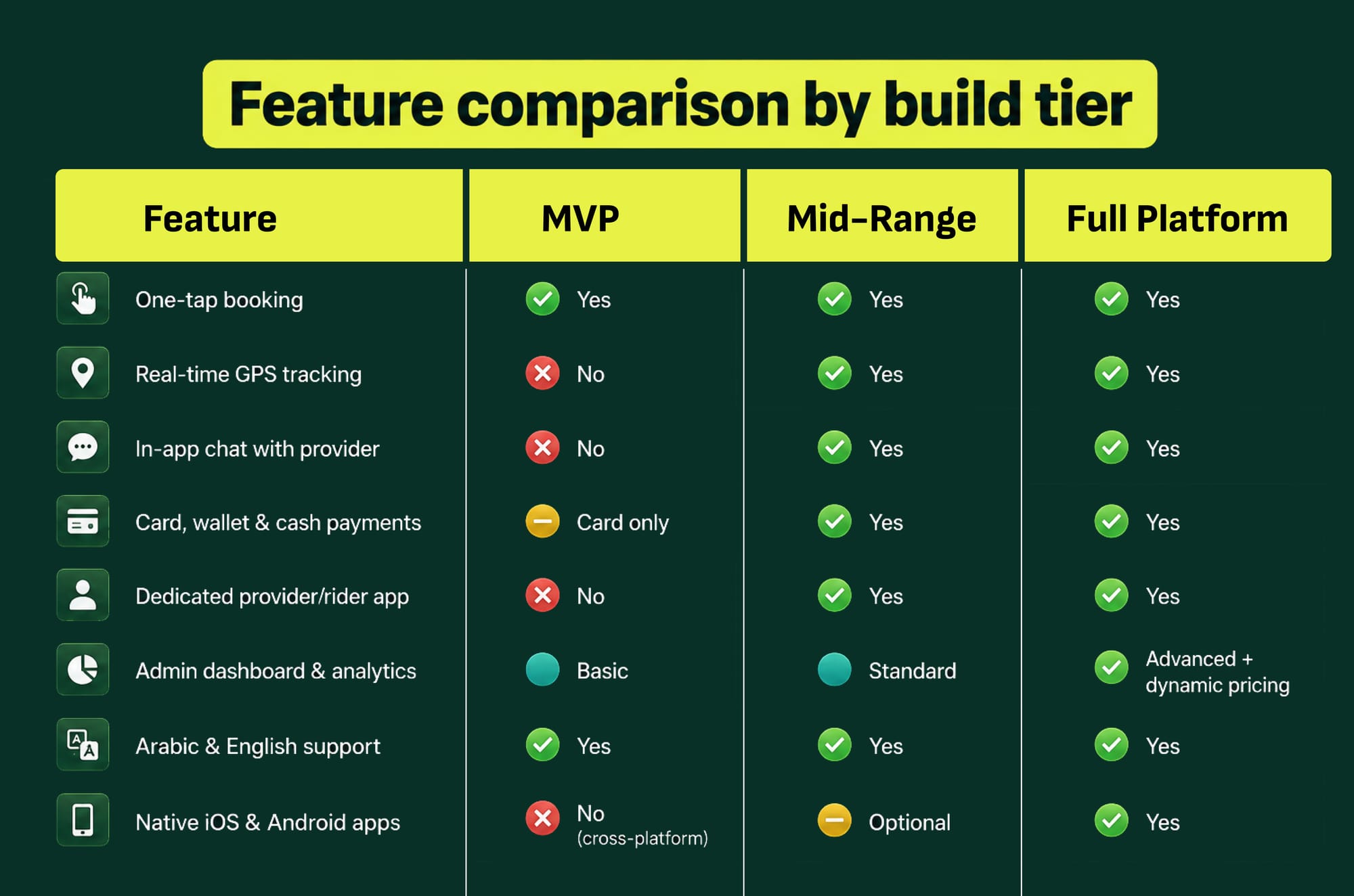
As a general estimate, a basic MVP on-demand app in the UAE typically starts in the tens of thousands of dirhams, while a fully customized platform with multiple apps and advanced integrations can reach six figures.
A practical approach is to launch with an MVP first. Build the core features users need, gather real customer feedback, and expand with advanced capabilities like AI, loyalty programs, and detailed analytics as your business grows.

Choosing the right development partner is just as important as choosing the right technology. While many agencies can build an app, fewer can deliver a scalable, secure platform designed for long-term growth in the UAE market.
Look for a partner with:
The right partner helps reduce maintenance costs, improve customer retention, and build a platform that grows with your business—avoiding costly rebuilds caused by rushed development.
Whether you're launching your first booking app, expanding a delivery platform, or upgrading an existing solution, LoudOwls combines technical expertise with deep knowledge of the UAE market to help you build an app that's designed to last.
1. How long does it take to build an on-demand booking app or delivery app in the UAE?
A focused MVP usually takes eight to fourteen weeks. A full-featured platform with custom design and multiple integrations can take four to six months.
2. Do I need separate apps for customers, providers, and admin?
For most on-demand models, yes. Customer needs and provider needs are different enough that combining them into one app tends to hurt both sides of the experience.
3. What is the typical cost range for on-demand app development in UAE projects like this?
It depends on scope, but a lean MVP generally starts in the tens of thousands of dirhams, while a fully custom, multi-app platform can reach the low hundreds of thousands. Get a scoped quote rather than leaning on a general range.
4. Should I build native apps or go cross-platform?
Cross-platform works well for an MVP or a budget-conscious launch. Native development tends to be worth the extra spend once you are scaling and performance becomes a real differentiator.
5. How do I choose the right on-demand app development company in the UAE?
Look for regional experience, visible post-launch support, transparent pricing, and existing apps you can actually test yourself. Be wary of any agency unwilling to walk you through its past work in detail.
6. What ongoing costs should I expect after launch?
Server hosting, third-party API fees, app store maintenance, bug fixes, and periodic feature updates. Budgeting roughly 15 to 20 per cent of your build cost annually for upkeep is a reasonable starting point.
7. Can an existing business add an on-demand app without disrupting current operations?
Yes. Most businesses run the app alongside existing channels during a transition period, then gradually shift volume across as customer adoption grows.
QUICK SUMMARY: 1. This blog covers the ten leading dating apps operating in th
LoudOwls
Quick Summary * The global supply chain visibility software market in 2025 was
LoudOwls
QUICK SUMMARY- 1. Dubai has plenty of app companies; finding a good one is the
LoudOwls